Planning & Forecasting
Why Your Planning Software is Holding You Back
AUTHOR
Deb Mohanty
There's a quiet crisis playing out in supply chain planning teams across the industry. Companies have spent millions on Advanced Planning Systems and endured painful multi-year implementations, and yet planners still feel like they're fighting their tools rather than making better decisions. Spreadsheets persist. Data pipelines break. Custom reports live in PowerBI, disconnected from the model that generated the numbers. And when the business changes, a new channel, a new sourcing pattern, a promotion campaign, the whole cycle starts again.
Your planners aren't the problem. The architecture is. Traditional APS vendors were built with a fundamental limitation, and they've spent thirty years positioning it as a feature.
The Decision Mesh Problem: You Don't Own the Full Chessboard
Most APS vendors specialize. One excels at demand forecasting. Another at network optimization. A third at S&OP. Each is sold as a module or a separate product, with its own data model, its own interface, its own implementation cycle, and its own contract.
That specialization fractures your planning stack.
Strategic network decisions live in one system. S&OP in another. Inventory policy in a third. Fulfillment and allocation logic gets built as a custom module or lives in a spreadsheet. And when you need a frontier use case, say, a cold chain ATP allocation with custom prioritization logic, you're in whitespace that no vendor covers, building something from scratch and stitching it into a chain of systems that were never designed to talk to each other.
This is the integration tax. Every handoff between systems is a place where decision integrity erodes. Data gets stale. The allocation logic doesn't know what the S&OP model decided about run strategies. The inventory policy doesn't reflect the latest sourcing pattern. You end up making decisions in isolation, patching together insights from four different tools.
With Lyric, that tax disappears. The platform spans the full Decision Mesh, from strategic network design to S&OP and S&OE, demand and inventory to fulfillment and transportation, on a single interoperable semantic model. A sourcing decision at the strategic level flows directly into the inventory policy engine. An S&OP run strategy flows into your operational planning system. Change a demand scenario and every downstream decision is recomputed in the same application. There is nothing to integrate because nothing is separate.
The Deployment Illusion: What "Going Live" Actually Costs You
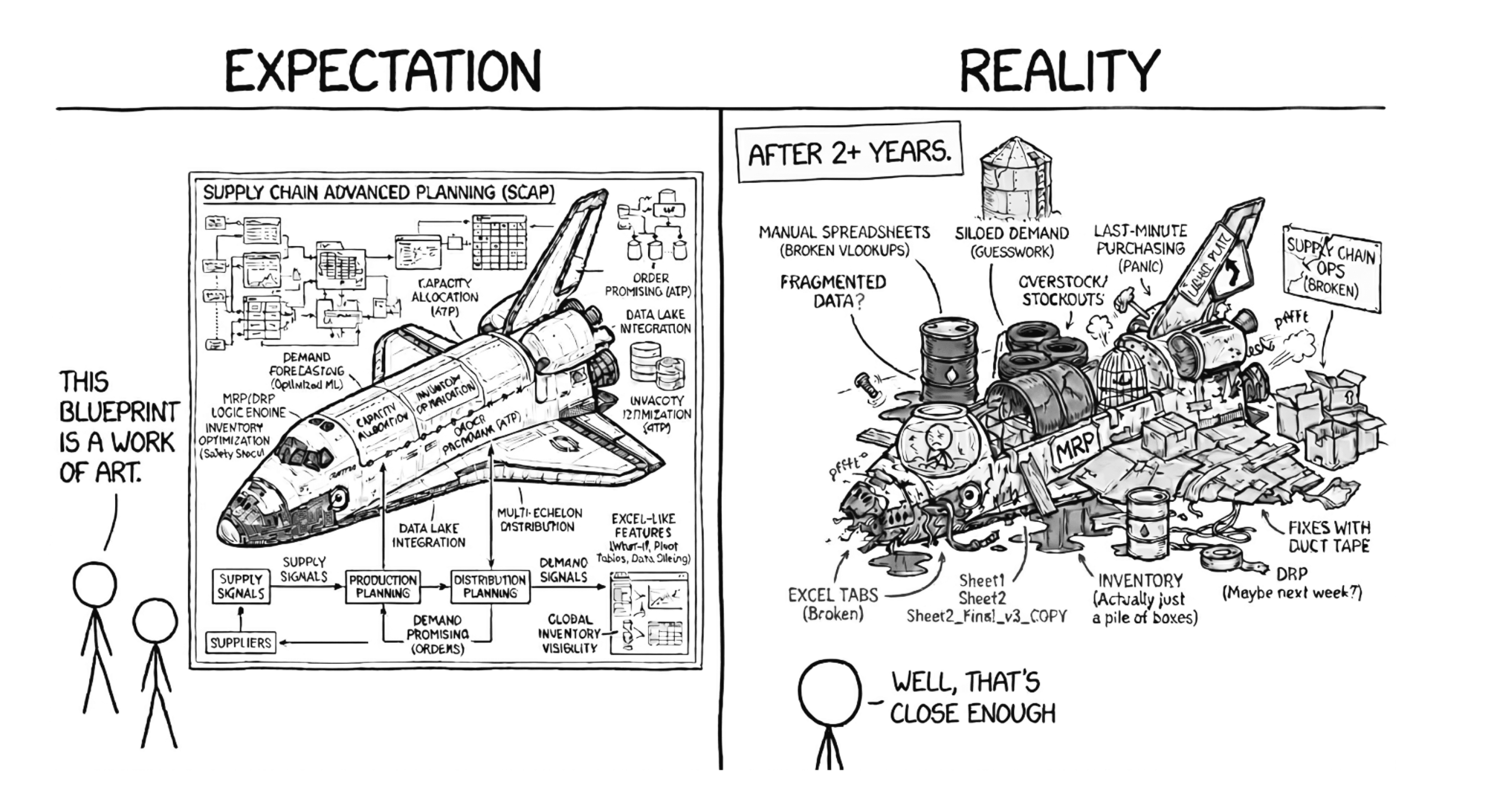
A company decides to go live with S&OP and RCCP. The data pipeline from SAP is the customer's responsibility. The custom allocation logic for prebuild inventory at cold chain distribution centers needs to be built outside the system and integrated back in. Financial reporting tailored to the S&OP process becomes a PowerBI project, disconnected, static, requiring manual refresh. Routing decisions from S&OP into the operational planning system becomes yet another integration project. Months pass. By the time the system is "live," the model is already partially stale.
Traditional APS vendors have normalized this. They call it "implementation" and treat it as the customer's problem.
The outcome on Lyric is different from the first week. Your team connects to SAP via OData or data lake and builds the pipeline in days. Financial reports are fully interactive with the live model, not static exports in a disconnected BI tool. S&OP decisions flow directly into downstream operational systems without a separate integration project. Custom allocation logic lives inside the same platform rather than hanging off it.
Everything that used to be an IT project becomes composable, and what used to take months compresses into the first iteration.
A Living Model: Composability Without Complexity
Traditional APS implementations are largely static. The model you go live with is the model you're stuck with, until you fund another implementation cycle. Business drift accumulates silently. New channels, new sourcing strategies, new campaign logic pile up as workarounds outside the system.
Lyric works differently. In the first iteration, you go live quickly with what matters most: safety stock rules, priority-based planning, manual demand scenarios. In the second, you layer in costs and campaign logic. In the third, probabilistic demand prediction with covariates. Each iteration is additive, not disruptive. The solutions team, business transformation, IT, Lyric, and partners, grows increasingly self-sufficient with each cycle. By iteration three or four, you're likely extending the model yourself, at a fraction of early implementation costs, with some planners building ad hoc analytics independently.
The model evolves with the business.
The Self-Service Myth: Who's Actually Making Decisions?
In most APS deployments, exploring a scenario means going through IT or the vendor's professional services team to change model parameters or run new scenarios. Want to model a different safety stock policy? Ticket submitted. Want to stress test a sourcing change against a demand spike? Wait for the next quarterly model refresh. This bottleneck isn't disclosed in sales cycles. It emerges six months after go-live.
The practical difference in Lyric is that your planners don't wait. From the first iteration, you can change core assumptions, target stock levels, run strategies, sourcing coverage, distribution assignments, demand and promotion inputs, and run scenarios immediately, within the same application. Probabilistic predictions surface what's likely to happen. Interactive scenarios let planners test assumptions in real time. Simulations stress-test strategies before they're committed. You can automate scenario generation and compare outcomes side by side, in the flow of the planning cycle.
The TCO Argument Nobody Talks About Plainly
The true cost of a traditional APS stack is systematically understated. Software ARR is the visible number. The real cost includes implementation services from a global SI, custom integration build and maintenance for every whitespace use case, parallel BI tooling, re-implementation costs when the business shifts, and ongoing professional services dependency for model updates.
Lyric's architecture changes this math directly. Go-lives are shorter because data-to-decisions is owned by the platform, not assembled from outside. Iterations are faster and cheaper because the model is composable, not monolithic. Your team's footprint required to operate and evolve the solution gets smaller, with fewer SI resources, less ongoing vendor dependency, and your team becoming self-sufficient over time. The difference is structural, not marginal.
A Different Kind of Planning Platform
The supply chain planning software market has spent thirty years telling companies that complexity is inevitable, implementation is slow, and the gap between what the system can do and what the business needs is just the cost of doing business.
Lyric eliminates the integration tax with a single interoperable Decision Mesh, collapses deployment timelines with a no-code composable architecture, and puts decision-making back in the hands of planners, not IT queues. The model grows with your business instead of constraining it.
The question isn't whether your current APS is sophisticated. It probably is. The question is whether it's making your planners faster and your decisions more integrated. If the honest answer is "not as much as we'd hoped," that's exactly what Lyric was built to solve.
Read more
Leadership & Decision Culture
The Counterpoint
May 27, 2026
Dinesh Natarajan
read more
Decision Intelligence
No Destination Stays Still
May 5, 2026
Brooke Collins & Sonja Jones
read more
Optimization Science & Modeling
Why Optimization Needs Simulation
Apr 14, 2026
Ratnaji Vanga
read more
Engineering Insights
The Real Reason Your Planning System Slows Down
Apr 13, 2026
Aditya Jaroli & Pradeep Vijayakumar
read more
Planning & Forecasting
Teaching Supply Plans to See Around Corners
Apr 6, 2026
Ugo Rosolia
read more
Planning & Forecasting
Why Your Planning System Should Think Like a Perishable
Mar 23, 2026
Brian Howard Dye
read more
Planning & Forecasting
The Modeling-Planning Divide Was Always a Technology Problem
Mar 19, 2026
Vish Oza & Deb Mohanty
read more
Leadership & Decision Culture
The Innovation Tax: Why Your Best Work Doesn't Compound
Feb 18, 2026
Brittany Elder
read more
Leadership & Decision Culture
What Sudoku Teaches Us About Enterprise Software
Feb 17, 2026
Akshat Jain
read more
Decision Intelligence
Taming the Toughest Problems in Transportation
Dec 18, 2025
Amit Hooda & Priyesh Kumar
read more
Leadership & Decision Culture
Why 30% of Packaged Food Never Reaches a Consumer
Dec 22, 2025
Srivatsan Kadambi Seshadri & Thilak Satya Sree
read more
Leadership & Decision Culture
How to Plan When Nothing Goes According to Plan
Dec 15, 2025
Dr. Nilendra Singh Pawar
read more
Architecture & Composability
Why We Fall Back to Heuristics
Nov 24, 2025
Frank Corrigan
read more
Architecture & Composability
What You Group is What You See
Nov 3, 2025
Frank Corrigan
read more
Architecture & Composability
The Cost of Curiosity
Sep 24, 2025
Brooke Collins
read more
Leadership & Decision Culture
Lyric Named a 2025 Gartner® Cool Vendor in Cross-Functional Supply Chain Technology
Sep 2, 2025
Sara Hoormann
read more
Leadership & Decision Culture
Built for Builders. Backed to Scale.
Aug 5, 2025
Ganesh Ramakrishna
read more
Architecture & Composability
Generative AI meets Time Series Forecasting
May 2, 2025
Deb Mohanty
read more
Architecture & Composability
The Dying Art of Supply Chain Modeling
Apr 15, 2025
Milind Kanetkar
read more
Leadership & Decision Culture
Tariffs, Trade Wars, and the AI Advantage: Why Fast Modeling Wins
Apr 7, 2025
Lyric Team | Prime Contributors - Laura Carpenter, Victoria Richmond, Saurav Sahay
read more
Architecture & Composability
Lyric Leverages NVIDIA cuOpt to Elevate Supply Chain AI
Mar 18, 2025
Sara Hoormann
read more
Architecture & Composability
The Technology Behind Modeling at Scale
Mar 14, 2025
Ganesh Ramakrishna
read more
Leadership & Decision Culture
Our Dream is to Make Every Supply Chain AI-First
Oct 18, 2023
Ganesh Ramakrishna
read more
Architecture & Composability
What Is a Feature Store Anyway?
Mar 14, 2024
Sara Hoormann
read more
Leadership & Decision Culture
Supply Chain AI Ain’t Easy
Feb 20, 2023
Ganesh Ramakrishna & Sara Hoormann
read more
Decision Intelligence
Four Ways to Improve Supply Chain Operations with Machine Learning
Jan 26, 2023
Vish Oza
read more
Architecture & Composability
Prediction is the New Visualization
May 30, 2024
Frank Corrigan
read more