Leadership & Decision Culture
The Counterpoint
AUTHOR
Dinesh Natarajan
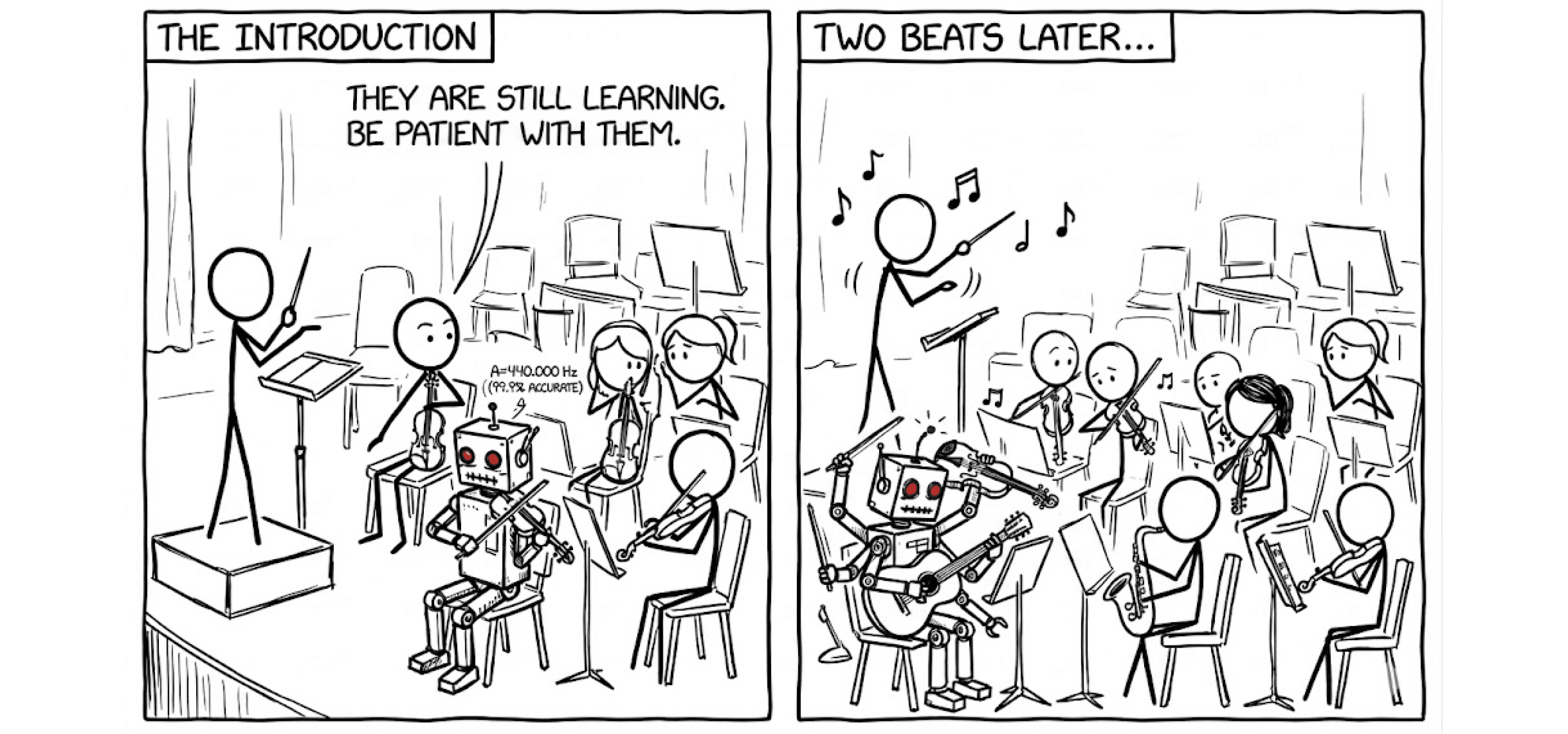
About twelve months ago, supply chain decisions had one author. They now have two. Nobody has been formally introduced. On one side are algorithms and agents producing recommendations at a pace suggesting they have somewhere else to be. On the other side is a human, still responsible for making the call. The two of them look, most days, like a chamber ensemble and a jazz trio booked into the same room by mistake.
There is, as it happens, an answer to this. It is roughly three hundred years old and goes by the name counterpoint. Two voices moving independently and somehow belonging together. Johann Sebastian Bach built his life's work on it. Ilaiyaraaja powered half a century of Indian cinema with it, often while hiding alarming amounts of musical engineering in plain sight. Supply chain has, with characteristic delay, arrived at the same need.
Counterpoint requires two things: two voices and a score that lets them play together. Supply chain has the voices. The score, on current evidence, appears to be missing.
This is not entirely the supply chain's fault. It spent decades collecting mathematics the way medieval monasteries collected manuscripts: carefully, expensively, and mostly in places nobody could access without permission. The math existed. It simply arrived at inconvenient moments like a week after the decision needed making. Data, compute, and algorithms have, finally, started compounding on each other. The result is algorithmic intelligence: the polite term for mathematics that turns up to meetings on time. Half the problem, after decades, is solved.
The other half was always the harder one. Supply chain decisions have never run on math alone. They also need judgment, inference, and pattern recognition. The ability to look at incomplete information and conclude something feels wrong despite not being able to prove it in a spreadsheet. Agents are starting to handle the second half and more. Together, algorithmic and agentic intelligence form one machine register. Call it AI². The two compound into something more than either alone. Math arrives on time. The machine now has opinions. This is, on balance, the more unsettling development. The human is now responsible for knowing which ones to trust.
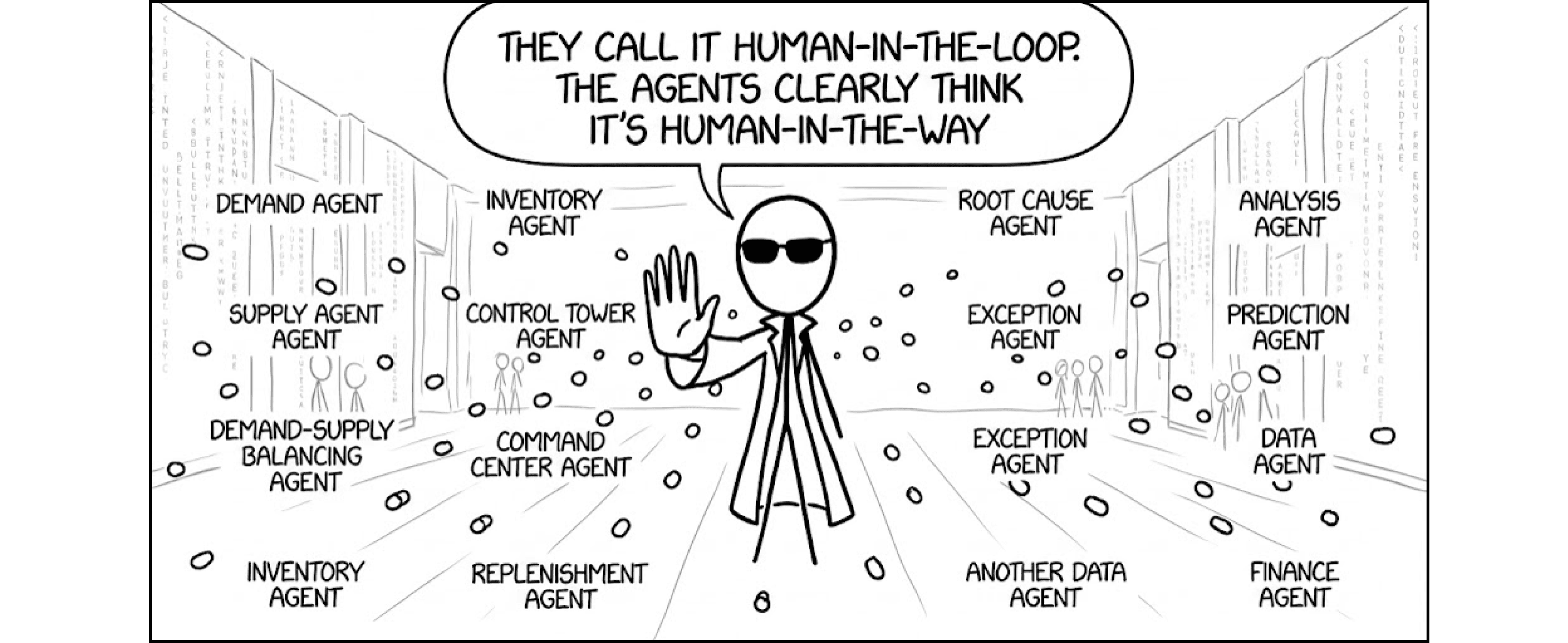
More voices will join the register. Every function will field its own. Recommendations will multiply. Opinions will contradict. The human will spend more time refereeing arguments between systems that do not entirely know they are in one. The Gartner Symposium opened with this question: how are decisions made, who makes them, and how is value created. The answer, it turns out, is a score.
Orchestras play from a written one. Supply chains play from an invisible one: who decides what, who follows whom, who gets to improvise, who gets ignored. Most simply never wrote the score. We call that score the Decision Mesh. A decision-first view of the supply chain: every strategic, tactical, and operational choice made visible, connected bidirectionally across silos, and composable as needs change. Unlike Bach's, this score is never finished. As the business changes, the score changes with it. The Decision Mesh governs each supply chain decision: who makes the call and how often. The call goes to AI², to the human, or to the two in concert. Some decisions happen before breakfast. Others occur once per CEO tenure and trigger a migration pattern of steering committees. Each decision sits on it by how much math it demands and how much judgment it demands.
Every decision can be plotted on two axes, with some confidence. Some demand compute: thousands of SKUs, millions of constraints, the kind of scale only algorithms can hold. A replenishment decision is largely this: a category manager sets the policy at ninety-eight percent in-stock for strategic SKUs and ninety-two for the long tail. Agents play the line at scale, day after day, and bring the human back when assumptions break: a port strike, a supplier collapse, a demand signal nobody saw coming. Others demand fidelity: political timing, customer relationships, strategic promises made over dinner six months ago and forgotten by everyone except the customer. A $400 million investment in a new oil field is largely this. The hardest decisions demand both at once, and that is where counterpoint earns its keep. The score determines who leads on each: the machine, the human, or the two in concert. Knowing where a decision sits is half the work. Knowing who should play it is the other half.
Every organization writes this score differently. The same decision can sit in different places at different companies and still be right. Governing the new orchestra begins with writing the score itself: deciding which voice leads, which follows, when decisions escalate, and how humans, agents, and algorithms move together without collapsing into noise. Most organizations have not done this work. The score is still being written by accident.
That accidental score has a sound, and it is dissonance with better dashboards and higher token spend.
The CSCO's job has quietly become two jobs: composing the score in advance, and conducting from the podium when the score meets reality.
Both come down to deciding which voice plays which decision, holding the Mesh in tension, refusing to let confident agents wander into work that wants judgment, and refusing to let humans linger over work the math has already solved.
The organizations getting this right have stopped treating agents as a procurement problem and started treating them as a governance problem. They are mapping decisions before deploying agents, naming a single owner for each, defining what happens when the math is unsure, and writing the score before adding more players to the room. None of this fits in a procurement category, and no agent will do it on your behalf.
Counterpoint is what happens when someone takes the chair and decides to compose. Everything else is a very expensive orchestra without something to play.
Read more
Planning & Forecasting
Supply Chain has a Multiverse Problem
Jul 17, 2026
Brian Dye
read more
Decision Intelligence
No Destination Stays Still
May 5, 2026
Brooke Collins & Sonja Jones
read more
Optimization Science & Modeling
Why Optimization Needs Simulation
Apr 14, 2026
Ratnaji Vanga
read more
Engineering Insights
The Real Reason Your Planning System Slows Down
Apr 13, 2026
Aditya Jaroli & Pradeep Vijayakumar
read more
Planning & Forecasting
Teaching Supply Plans to See Around Corners
Apr 6, 2026
Ugo Rosolia
read more
Planning & Forecasting
Why Your Planning Software is Holding You Back
Apr 1, 2026
Deb Mohanty
read more
Planning & Forecasting
Why Your Planning System Should Think Like a Perishable
Mar 23, 2026
Brian Howard Dye
read more
Planning & Forecasting
The Modeling-Planning Divide Was Always a Technology Problem
Mar 19, 2026
Vish Oza & Deb Mohanty
read more
Leadership & Decision Culture
The Innovation Tax: Why Your Best Work Doesn't Compound
Feb 18, 2026
Brittany Elder
read more
Leadership & Decision Culture
What Sudoku Teaches Us About Enterprise Software
Feb 17, 2026
Akshat Jain
read more
Decision Intelligence
Taming the Toughest Problems in Transportation
Dec 18, 2025
Amit Hooda & Priyesh Kumar
read more
Leadership & Decision Culture
Why 30% of Packaged Food Never Reaches a Consumer
Dec 22, 2025
Srivatsan Kadambi Seshadri & Thilak Satya Sree
read more
Leadership & Decision Culture
How to Plan When Nothing Goes According to Plan
Dec 15, 2025
Dr. Nilendra Singh Pawar
read more
Architecture & Composability
Why We Fall Back to Heuristics
Nov 24, 2025
Frank Corrigan
read more
Architecture & Composability
What You Group is What You See
Nov 3, 2025
Frank Corrigan
read more
Architecture & Composability
The Cost of Curiosity
Sep 24, 2025
Brooke Collins
read more
Leadership & Decision Culture
Lyric Named a 2025 Gartner® Cool Vendor in Cross-Functional Supply Chain Technology
Sep 2, 2025
Sara Hoormann
read more
Leadership & Decision Culture
Built for Builders. Backed to Scale.
Aug 5, 2025
Ganesh Ramakrishna
read more
Architecture & Composability
Generative AI meets Time Series Forecasting
May 2, 2025
Deb Mohanty
read more
Architecture & Composability
The Dying Art of Supply Chain Modeling
Apr 15, 2025
Milind Kanetkar
read more
Leadership & Decision Culture
Tariffs, Trade Wars, and the AI Advantage: Why Fast Modeling Wins
Apr 7, 2025
Lyric Team | Prime Contributors - Laura Carpenter, Victoria Richmond, Saurav Sahay
read more
Architecture & Composability
Lyric Leverages NVIDIA cuOpt to Elevate Supply Chain AI
Mar 18, 2025
Sara Hoormann
read more
Architecture & Composability
The Technology Behind Modeling at Scale
Mar 14, 2025
Ganesh Ramakrishna
read more
Leadership & Decision Culture
Our Dream is to Make Every Supply Chain AI-First
Oct 18, 2023
Ganesh Ramakrishna
read more
Architecture & Composability
What Is a Feature Store Anyway?
Mar 14, 2024
Sara Hoormann
read more
Leadership & Decision Culture
Supply Chain AI Ain’t Easy
Feb 20, 2023
Ganesh Ramakrishna & Sara Hoormann
read more
Decision Intelligence
Four Ways to Improve Supply Chain Operations with Machine Learning
Jan 26, 2023
Vish Oza
read more
Architecture & Composability
Prediction is the New Visualization
May 30, 2024
Frank Corrigan
read more