Decision Intelligence
No Destination Stays Still
AUTHOR
Brooke Collins & Sonja Jones
Supply chain software has historically been treated as a destination. Organizations evaluate it, implement it, conform to it, and operate in spite of its limitations. The implicit premise is that the business will eventually stabilize around the system, and the system will hold its shape long enough to be worth the effort of getting there.
That premise is breaking down. Businesses change faster than annual planning cycles can track. Supply chain shocks have become routine rather than exceptions, driving a cadence destination-state software was never designed to absorb. The decisions themselves: network design, inventory, transportation, planning, are increasingly understood as one connected system rather than separable problems for separate tools. Software built as a fixed endpoint cannot serve a business operating under any of those conditions, let alone all three.
Two organizations with almost nothing in common are running into this mismatch right now, from opposite directions.
The same mistake from opposite directions
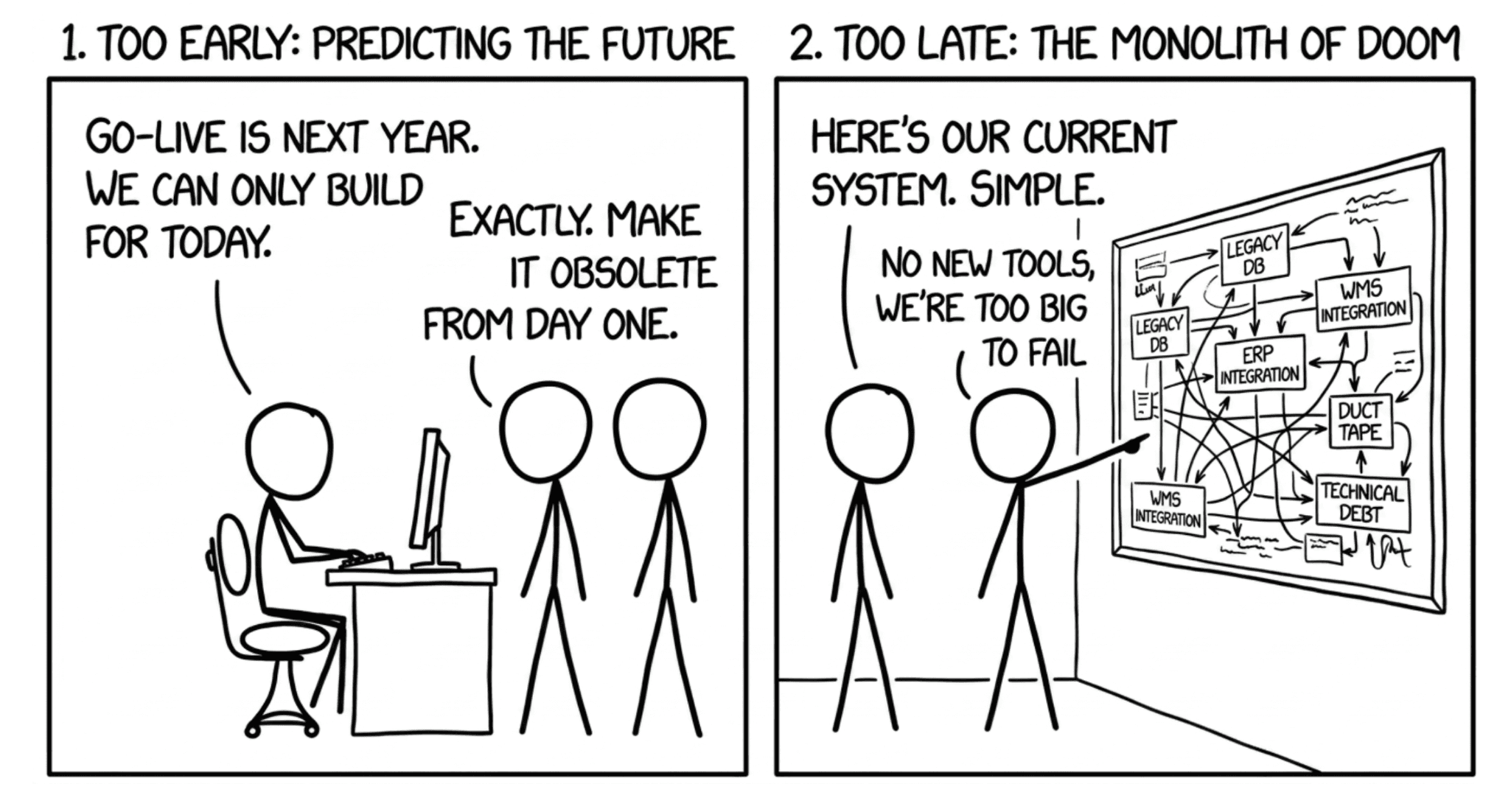
The first is a fast-growing company. It knows it needs better systems. It also knows that traditional supply chain software takes twelve or more months to implement, and that by the time the system goes live, the business has already changed. The org chart shifts, the network expands, the channels multiply, and the platform encoding yesterday's assumptions is only now coming online.
So the company waits for a more stable moment, a clearer picture, a future state defined enough to build toward without immediately outgrowing it.
The second is a large enterprise with mature systems already in place. The future state is often known. The decision to transition has already been made. What remains is timing the move. The existing system works but isn’t going to support the future. The case for waiting one more quarter is always available. So the transition stays on the horizon while work continues in the system the organization has already decided to leave.
Solution debt is the cost no one is tracking
That second situation produces a particularly damaging form of cost. Call it “Solution Debt”. It accumulates when organizations keep building decision-critical solutions in obsolete systems, because the timing question keeps the work happening in the wrong place while the future state waits on the horizon.
Solution debt is easy to overlook because it is perceived as discrete work. A solution answers a question. An analysis supports a decision. The work is done. But that framing no longer holds. Many solutions live on, get revised, and repurposed as conditions change. Others never turn off at all, evolving into living systems that continuously inform planning and operations. Value compounds over time.
When that compounding happens in a system the organization plans to leave, every revision adds to a debt accumulating beneath the surface.
That debt is rarely recoverable. Code can be refactored incrementally. But solutions encode how a business thinks, including its assumptions, constraints, and the institutional logic developed over years. Rebuilding that thinking inside a new system is not a technical task. It is a knowledge problem, and nuance is routinely lost. The subtlest cost is what never gets built at all. Teams sense when a platform is temporary, hesitate to invest, and avoid the more ambitious work that would feel stranded before it begins.
The cost of building where you're leaving
One global energy company confronted this directly as it approached the final year of a long-standing software contract. The default response would have been to wait it out. Instead the organization asked a different question. Given that we already know where we are going, what is the cost of continuing to build where we are? Every solution created in the existing system was future debt, locking institutional learning into a platform that could not carry it forward. Overlapping licenses were not wasteful. They were protection against a loss that would not become visible until it was already severe.
One root cause, two symptoms
The hypergrowth company and the enterprise in transition face different surface problems. One cannot find the right moment to commit. The other cannot find the right moment to move. Both are running into the same root cause. The destination model of supply chain software does not match how their businesses actually operate. The hypergrowth company cannot commit because no destination will stay still long enough to be worth reaching. The enterprise cannot transition cleanly because the solution work accumulating in its current system will not survive the move.
The real mistake is not implementing too early or too late. The question is not when to implement supply chain software. It is what kind of software can evolve as fast as the business does, and carry forward the work already done rather than forcing a restart.
Software built to evolve, not to arrive
That is what composability makes possible, and it addresses both situations from the same architectural premise. Software built as living infrastructure rather than as a destination.
For the hypergrowth company, composability removes the requirement for a stable moment before deployment can begin. Lyric deploys in weeks rather than months, and its architecture reconfigures as the business changes rather than encoding a fixed state the business then has to conform to.
For the enterprise managing a transition, composability gives the institutional work already done somewhere to go. Existing solutions and data science come into Lyric Studio as Green Notes, customer-owned IP that lives within the platform, sits alongside Lyric's catalog of scientific and logic-based Blue Notes, and becomes composable and reusable within the Decision Mesh. The work transfers into a system designed to carry it forward as living decision infrastructure rather than resetting as disposable studies.
The transition does not restart the compounding clock. It moves the clock to the right place.
The Goldilocks moment does not exist for either organization, and waiting for it is itself a decision. One that carries a cost most organizations are not tracking.
The question is not whether you can afford the overlap. It is whether you can afford another quarter of building in software designed for a world that no longer exists.
Read more
Planning & Forecasting
Supply Chain has a Multiverse Problem
Jul 17, 2026
Brian Dye
read more
Leadership & Decision Culture
The Counterpoint
May 27, 2026
Dinesh Natarajan
read more
Optimization Science & Modeling
Why Optimization Needs Simulation
Apr 14, 2026
Ratnaji Vanga
read more
Engineering Insights
The Real Reason Your Planning System Slows Down
Apr 13, 2026
Aditya Jaroli & Pradeep Vijayakumar
read more
Planning & Forecasting
Teaching Supply Plans to See Around Corners
Apr 6, 2026
Ugo Rosolia
read more
Planning & Forecasting
Why Your Planning Software is Holding You Back
Apr 1, 2026
Deb Mohanty
read more
Planning & Forecasting
Why Your Planning System Should Think Like a Perishable
Mar 23, 2026
Brian Howard Dye
read more
Planning & Forecasting
The Modeling-Planning Divide Was Always a Technology Problem
Mar 19, 2026
Vish Oza & Deb Mohanty
read more
Leadership & Decision Culture
The Innovation Tax: Why Your Best Work Doesn't Compound
Feb 18, 2026
Brittany Elder
read more
Leadership & Decision Culture
What Sudoku Teaches Us About Enterprise Software
Feb 17, 2026
Akshat Jain
read more
Decision Intelligence
Taming the Toughest Problems in Transportation
Dec 18, 2025
Amit Hooda & Priyesh Kumar
read more
Leadership & Decision Culture
Why 30% of Packaged Food Never Reaches a Consumer
Dec 22, 2025
Srivatsan Kadambi Seshadri & Thilak Satya Sree
read more
Leadership & Decision Culture
How to Plan When Nothing Goes According to Plan
Dec 15, 2025
Dr. Nilendra Singh Pawar
read more
Architecture & Composability
Why We Fall Back to Heuristics
Nov 24, 2025
Frank Corrigan
read more
Architecture & Composability
What You Group is What You See
Nov 3, 2025
Frank Corrigan
read more
Architecture & Composability
The Cost of Curiosity
Sep 24, 2025
Brooke Collins
read more
Leadership & Decision Culture
Lyric Named a 2025 Gartner® Cool Vendor in Cross-Functional Supply Chain Technology
Sep 2, 2025
Sara Hoormann
read more
Leadership & Decision Culture
Built for Builders. Backed to Scale.
Aug 5, 2025
Ganesh Ramakrishna
read more
Architecture & Composability
Generative AI meets Time Series Forecasting
May 2, 2025
Deb Mohanty
read more
Architecture & Composability
The Dying Art of Supply Chain Modeling
Apr 15, 2025
Milind Kanetkar
read more
Leadership & Decision Culture
Tariffs, Trade Wars, and the AI Advantage: Why Fast Modeling Wins
Apr 7, 2025
Lyric Team | Prime Contributors - Laura Carpenter, Victoria Richmond, Saurav Sahay
read more
Architecture & Composability
Lyric Leverages NVIDIA cuOpt to Elevate Supply Chain AI
Mar 18, 2025
Sara Hoormann
read more
Architecture & Composability
The Technology Behind Modeling at Scale
Mar 14, 2025
Ganesh Ramakrishna
read more
Leadership & Decision Culture
Our Dream is to Make Every Supply Chain AI-First
Oct 18, 2023
Ganesh Ramakrishna
read more
Architecture & Composability
What Is a Feature Store Anyway?
Mar 14, 2024
Sara Hoormann
read more
Leadership & Decision Culture
Supply Chain AI Ain’t Easy
Feb 20, 2023
Ganesh Ramakrishna & Sara Hoormann
read more
Decision Intelligence
Four Ways to Improve Supply Chain Operations with Machine Learning
Jan 26, 2023
Vish Oza
read more
Architecture & Composability
Prediction is the New Visualization
May 30, 2024
Frank Corrigan
read more