Planning & Forecasting
The Modeling-Planning Divide Was Always a Technology Problem
AUTHOR
Vish Oza & Deb Mohanty
For decades, the supply chain world operated with a clean division of labor. Modelers build strategic network designs and answer big-picture questions on annual cycles. Planners run the business: what to produce this week, where to ship it, how to keep customers happy when things go wrong. Different problems, different tools, different teams.
This separation was convenient. It was never fundamental. It was a function of technology constraints and organizational inertia, not any real difference in what these roles do.
Both are making decisions. Both need math. Both need to adapt when reality changes.
The result is a predictable cycle.
Planners spend the week gathering data and building a plan. Execution starts, and immediately they're firefighting. Why? Because the assumptions in the model are already outdated. The supplier lead time that was 2 weeks when the model was built is now 3. The demand forecast was thrown off by a competitor promotion no one predicted.
Planners adjust. They override the plan. They make judgment calls. Next week, they do it again.
Meanwhile, modelers are removed from this entirely. They're building next year's network optimization or running a capacity study for 2027. By the time they finish, the assumptions they started with are history.
Models used to be strategic blueprints: build once, execute for years. Demand, supply, and cost volatility have changed that. Planning teams aren't asking for new models. They're asking for help keeping existing models true to reality. The work doesn't end when a model is delivered. It begins there.
"The separation between modeling and planning is a function of legacy, not purpose."
The Ignored Quadrant: Tactical and Operational Modeling
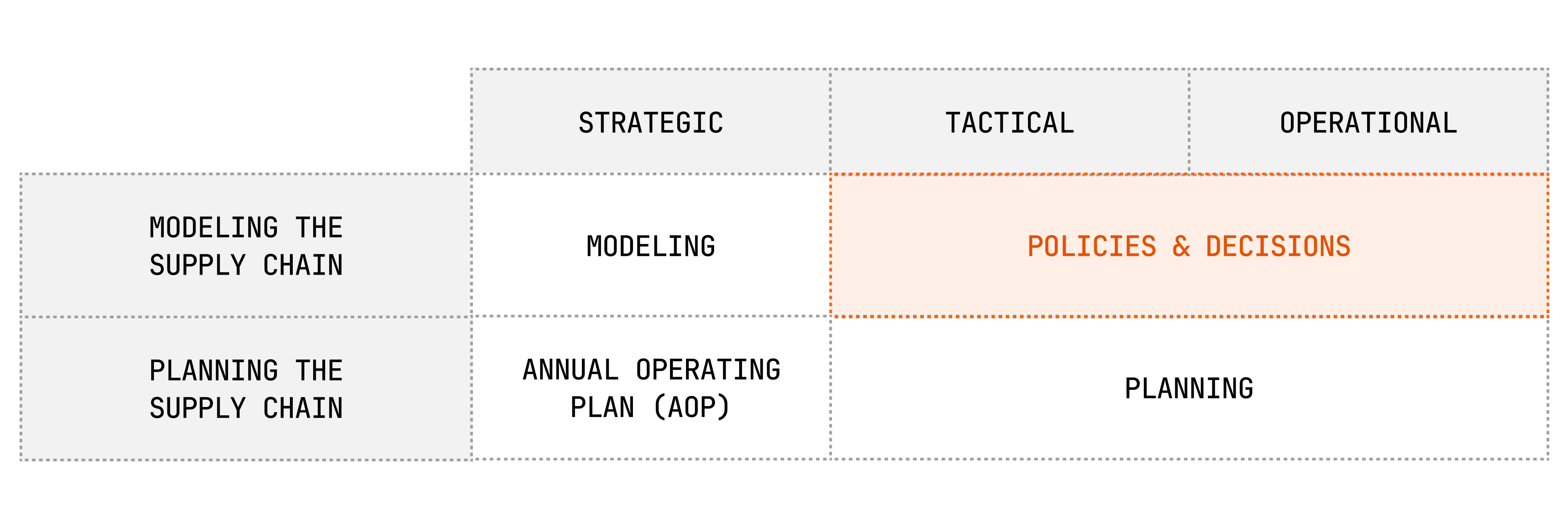
There's a missing capability that almost no one talks about: tactical and operational modeling.
This isn't about running the business day-to-day. It's about the policies and decisions that drive planning: are they current, are they optimal, and are they being tested frequently enough that firefighting becomes the exception rather than the rule.
For example:
Should safety stock policies be recalculated weekly rather than annually?
Can different production split scenarios be tested before committing to next month's plan?
What happens to the network if lead times stay elevated for another quarter?
These are modeling questions: math-intensive, scenario-driven, optimization-worthy. But they operate at planning timescales (weekly, monthly) and planning granularity (SKU-level, location-specific).
Planning systems aren't designed for this. They're built to execute plans, not experiment with assumptions. Planning teams aren't staffed or trained to run strategic what-ifs on a weekly cadence.
So the work doesn't happen. Planners keep using stale assumptions. Models drift further from reality. Plans feel obsolete before they're published.
Planning technology is designed to run the business. It was never designed to be a sandbox for asking questions.
Why This Changes With Lyric Studio
Lyric Studio was built specifically to collapse this divide.
The optimization algorithms that power strategic network design are the same algorithms that can optimize weekly replenishment, daily routing, or real-time inventory allocation. What changes isn't the math. It's the data model (what inputs matter), the time horizon (annual vs. weekly), and the granularity (product family vs. SKU).
When you use Lyric Studio for strategic modeling, extending into tactical and operational planning isn't a separate implementation. It's the same platform, the same algorithms, the same decision logic applied to different questions.
Planners become model managers
With Lyric Studio, planners don't execute static plans. They manage living models.
When a plan isn't working, when lead times shift, yields drop, or demand spikes, planners don't override the model with gut instinct.
They run scenarios across a predicted range of assumptions, so the plan they execute isn't optimized for one future. It's a decision built to perform across many.
This is only possible when the modeling layer is accessible, flexible, and fast enough to support iterative decision-making.
Strategic and operational decisions connect
A strategic network design decision flows directly into tactical planning and operational execution. But the connection runs deeper than cascade. When planners model a predicted range of promotion uplift, those scenarios propagate across the Decision Mesh: inventory positioning, production splits, routing. The plan that executes isn't built for the expected outcome. It's built to hold across the range.
What This Looks Like in Practice
Monthly rough-cut capacity planning: Instead of running annual capacity studies, a manufacturing team uses Lyric Studio to model capacity constraints at the production line level every month. The output isn't a static capacity report. It's a set of decisions stress-tested against multiple futures.
Weekly safety stock recalculation: A retail company stops treating safety stock as an annual exercise. Every week, updated lead time distributions, demand volatility, and service level targets feed into Lyric Studio's inventory optimization models. Planners receive refreshed recommendations based on current conditions, not assumptions from six months prior.
Real-time scenario testing: During an S&OP meeting, a CPG team tests the impact of shifting 20% of production to a co-manufacturer live in Lyric Studio and sees results in minutes. The meeting shifts from reviewing static outputs to exploring tradeoffs together.
The Convergence Is Inevitable
As S&OP cycles compress from monthly to weekly to continuous, the old separation breaks down. Organizations can't have modelers working on annual timescales while planners work on weekly ones. Strategic decisions can't be locked in spreadsheets while tactical decisions live in rigid planning systems.
That's not two functions. It's one decision system.
The Bottom Line
The wall between modeling and planning was never about the work itself. It was about technology limitations that no longer exist.
Lyric Studio's composable, math-first approach collapses that wall. The same algorithms, the same decision logic, one platform, applied from strategic modeling through tactical planning to operational execution.
Stop treating modeling and planning as separate worlds. They're different lenses on the same set of interconnected decisions.
The organizations that make this shift won't just plan better. They'll decide better, faster, and more often than those still operating with a divided stack.
In a world where conditions change daily, that's a competitive advantage.
This piece is adapted from a session held at Empower India 2025.
Read more
Planning & Forecasting
Supply Chain has a Multiverse Problem
Jul 17, 2026
Brian Dye
read more
Leadership & Decision Culture
The Counterpoint
May 27, 2026
Dinesh Natarajan
read more
Decision Intelligence
No Destination Stays Still
May 5, 2026
Brooke Collins & Sonja Jones
read more
Optimization Science & Modeling
Why Optimization Needs Simulation
Apr 14, 2026
Ratnaji Vanga
read more
Engineering Insights
The Real Reason Your Planning System Slows Down
Apr 13, 2026
Aditya Jaroli & Pradeep Vijayakumar
read more
Planning & Forecasting
Teaching Supply Plans to See Around Corners
Apr 6, 2026
Ugo Rosolia
read more
Planning & Forecasting
Why Your Planning Software is Holding You Back
Apr 1, 2026
Deb Mohanty
read more
Planning & Forecasting
Why Your Planning System Should Think Like a Perishable
Mar 23, 2026
Brian Howard Dye
read more
Leadership & Decision Culture
The Innovation Tax: Why Your Best Work Doesn't Compound
Feb 18, 2026
Brittany Elder
read more
Leadership & Decision Culture
What Sudoku Teaches Us About Enterprise Software
Feb 17, 2026
Akshat Jain
read more
Decision Intelligence
Taming the Toughest Problems in Transportation
Dec 18, 2025
Amit Hooda & Priyesh Kumar
read more
Leadership & Decision Culture
Why 30% of Packaged Food Never Reaches a Consumer
Dec 22, 2025
Srivatsan Kadambi Seshadri & Thilak Satya Sree
read more
Leadership & Decision Culture
How to Plan When Nothing Goes According to Plan
Dec 15, 2025
Dr. Nilendra Singh Pawar
read more
Architecture & Composability
Why We Fall Back to Heuristics
Nov 24, 2025
Frank Corrigan
read more
Architecture & Composability
What You Group is What You See
Nov 3, 2025
Frank Corrigan
read more
Architecture & Composability
The Cost of Curiosity
Sep 24, 2025
Brooke Collins
read more
Leadership & Decision Culture
Lyric Named a 2025 Gartner® Cool Vendor in Cross-Functional Supply Chain Technology
Sep 2, 2025
Sara Hoormann
read more
Leadership & Decision Culture
Built for Builders. Backed to Scale.
Aug 5, 2025
Ganesh Ramakrishna
read more
Architecture & Composability
Generative AI meets Time Series Forecasting
May 2, 2025
Deb Mohanty
read more
Architecture & Composability
The Dying Art of Supply Chain Modeling
Apr 15, 2025
Milind Kanetkar
read more
Leadership & Decision Culture
Tariffs, Trade Wars, and the AI Advantage: Why Fast Modeling Wins
Apr 7, 2025
Lyric Team | Prime Contributors - Laura Carpenter, Victoria Richmond, Saurav Sahay
read more
Architecture & Composability
Lyric Leverages NVIDIA cuOpt to Elevate Supply Chain AI
Mar 18, 2025
Sara Hoormann
read more
Architecture & Composability
The Technology Behind Modeling at Scale
Mar 14, 2025
Ganesh Ramakrishna
read more
Leadership & Decision Culture
Our Dream is to Make Every Supply Chain AI-First
Oct 18, 2023
Ganesh Ramakrishna
read more
Architecture & Composability
What Is a Feature Store Anyway?
Mar 14, 2024
Sara Hoormann
read more
Leadership & Decision Culture
Supply Chain AI Ain’t Easy
Feb 20, 2023
Ganesh Ramakrishna & Sara Hoormann
read more
Decision Intelligence
Four Ways to Improve Supply Chain Operations with Machine Learning
Jan 26, 2023
Vish Oza
read more
Architecture & Composability
Prediction is the New Visualization
May 30, 2024
Frank Corrigan
read more