Planning & Forecasting
Why Your Planning System Should Think Like a Perishable
AUTHOR
Brian Howard Dye
Yogurt has a shelf life. So does a plan that can't keep up.
Before I got deep into enterprise B2B software, I was a demand planner. Planning back then was something you prepared for. You blocked your calendar, pulled data from multiple systems, and waited for someone to refresh a cube or send the latest extract. Then you built scenarios, slowly.
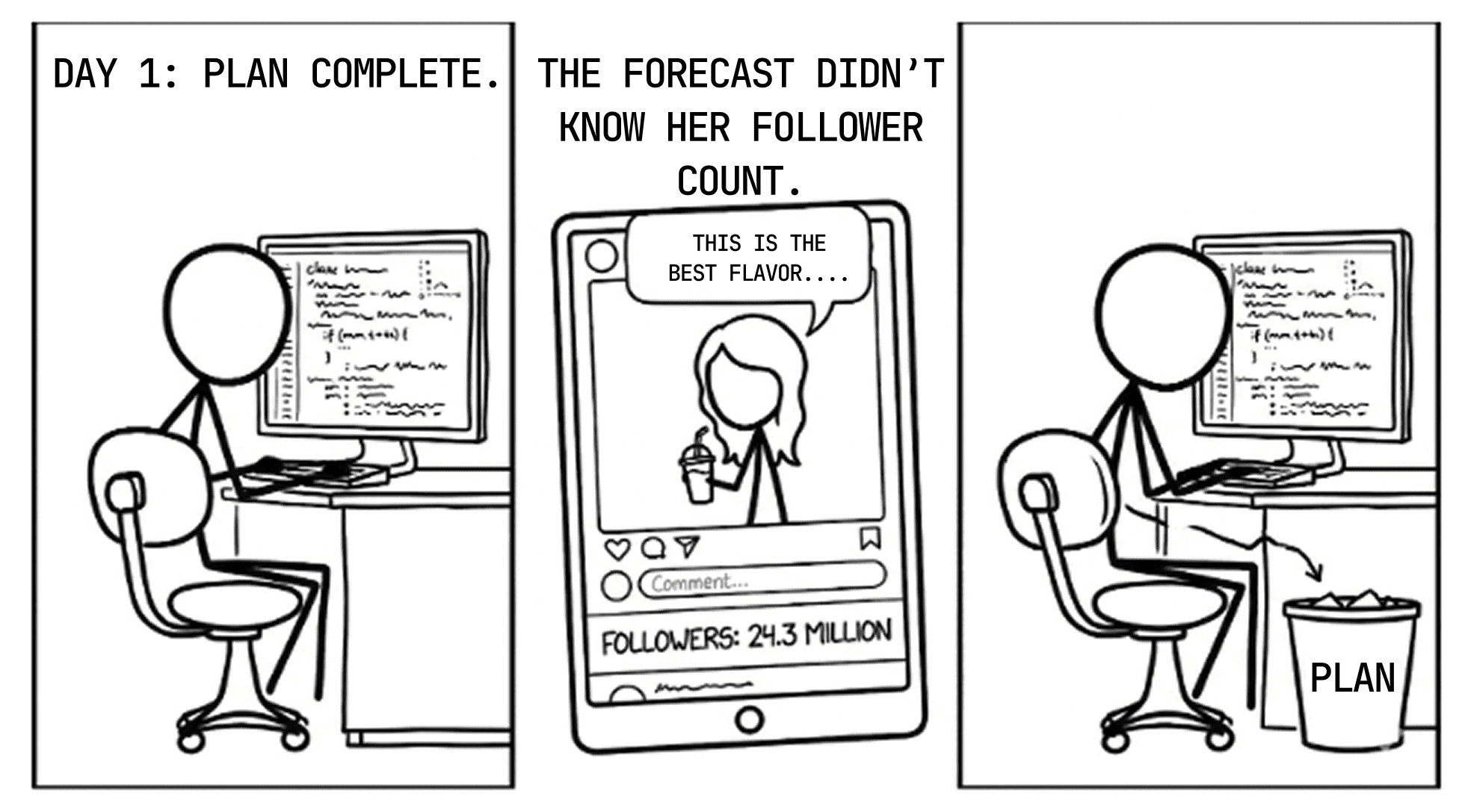
Think about what that looked like for a yogurt manufacturer running 150+ SKUs with a 35-day shelf life and eight-hour flavor changeovers. By the time your scenario comparing Greek vs. traditional production volumes had finished running, the retailer had already moved their promotional calendar, the weather forecast had shifted, and the influencer driving strawberry smoothie demand had posted something new.
Your scenario answered a question nobody was asking anymore.
In industries with shorter product lifecycles, perishability, or rapid demand swings, the cost of slow planning compounds quickly. Delays in decision-making don't just affect efficiency. They affect revenue, margin, and service.
Three Stages of Planning Maturity
The earliest stage was largely manual and batch-driven. Planning lived in spreadsheets and periodic system runs. Data was stale by the time it was reviewed, and scenarios were expensive to create.
The next stage brought powerful planning platforms. These systems centralized data and embedded advanced algorithms, but they were rigid. Customization meant long configuration projects. AI existed, but typically as a feature layered on top of a fixed structure.
What we are seeing now is a third stage: planning platforms that are composable by design, event-driven rather than calendar-bound, and built to incorporate AI natively into how decisions get made.
What Defines the Current Stage
Three shifts define modern planning:
First, data integration no longer assumes a blank slate. Modern platforms arrive with connectors that ingest demand signals, supply data, and external indicators continuously. Consider what that looks like in practice: POS velocity data flowing in from Kroger and Walmart simultaneously. A Google Trends spike in "protein smoothie" searches registering alongside a weather forecast calling for a heat wave across Atlanta, Charlotte, and Tampa. A social media monitoring feed flagging that a fitness influencer post has generated 47,000 mentions of your strawberry product in 72 hours. None of that is useful sitting in separate systems. The value is in it arriving together, in real time, ready for a planning team that can act on it.
Second, low-code platforms have matured in meaningful ways. Modern low-code platforms are composable. Planners and business users can assemble views, metrics, and logic to reflect how decisions actually get made. A yogurt manufacturer running a heat wave playbook doesn't need an IT project to add a rule that says: if Southeast temperatures are forecast above 90°F with 85% confidence, surface demand uplift modeling for Greek and smoothie SKUs. That logic can live close to the decision, defined by the people who understand the business.
Third, automation has moved planning from something that runs on a calendar to something that responds to change.
Automation Turns Signals into Decisions
Data alone doesn't change outcomes. Automation connects signals to action.
Here's what that looks like in practice. On a Thursday, demand sensing signals show Greek yogurt velocity running 18% above prior month. Kroger is sitting at 4.8 days of inventory against a 5-day reorder point. Walmart has a feature promotion locked in for Week 3 with a historical lift of 35-50%. The heat wave is 87% confident. An AI-adjusted forecast lands at 687,000 units per week, up from a baseline of 485,000.
By Friday, the system has built four probability-weighted scenarios: from the "Perfect Storm" at 35% probability, to supply disruption, to promotional underperformance, each with specific triggers, contingency logic, and decision gates. A recommendation surfaces: increase Greek yogurt production 35%, not the full 42%, with a flex-up trigger ready if Walmart DC orders exceed 30% of baseline by Day 8. The expected value across probability-weighted scenarios: +$187,000 over three weeks compared to traditional sequential planning.
In the past, that analysis would have arrived after the promotional window had already started. By the time scenarios were ready, the debate had shifted from what should we do to which version is least wrong.
Today, those workflows are defined by the business.
Automation doesn't replace judgment. It removes friction around it.
Where AI Fits
AI plays a role in this stage of planning, but it's not the headline. In the yogurt example, machine learning is surfacing the structural demand shift signal: Greek yogurt velocity sustained above 15% for four consecutive weeks, traditional yogurt declining for eight, and recommending a permanent adjustment to safety stock targets.
Not because of a promotion. Because the underlying category is moving.
Call it the whey forward: a system that doesn't just react to what happened, but learns from what's changing.
What matters isn't the model itself, but whether it is native to how planning decisions are built, evaluated, and revised. AI augments decision-making. It doesn't obscure it.
Planning Is Becoming a System
Modern planning assumes uncertainty is constant. It treats planning as a system that senses, evaluates, and responds. For a yogurt manufacturer, that means a long-term network optimization study is triggered automatically when structural demand shift signals cross a threshold, not when someone finally has time to commission one.
The hardest part of early planning wasn't the complexity. It was the lag between insight and action. You could see change coming. You just couldn't move fast enough to do anything about it.
Modern planning closes that gap.
Like yogurt, it only works when the culture is alive: sensing its environment, adapting continuously, and never waiting for the calendar to catch up.
Planning hasn't disappeared. It has finally started to move at the speed the business already expects.
Read more
Planning & Forecasting
Supply Chain has a Multiverse Problem
Jul 17, 2026
Brian Dye
read more
Leadership & Decision Culture
The Counterpoint
May 27, 2026
Dinesh Natarajan
read more
Decision Intelligence
No Destination Stays Still
May 5, 2026
Brooke Collins & Sonja Jones
read more
Optimization Science & Modeling
Why Optimization Needs Simulation
Apr 14, 2026
Ratnaji Vanga
read more
Engineering Insights
The Real Reason Your Planning System Slows Down
Apr 13, 2026
Aditya Jaroli & Pradeep Vijayakumar
read more
Planning & Forecasting
Teaching Supply Plans to See Around Corners
Apr 6, 2026
Ugo Rosolia
read more
Planning & Forecasting
Why Your Planning Software is Holding You Back
Apr 1, 2026
Deb Mohanty
read more
Planning & Forecasting
The Modeling-Planning Divide Was Always a Technology Problem
Mar 19, 2026
Vish Oza & Deb Mohanty
read more
Leadership & Decision Culture
The Innovation Tax: Why Your Best Work Doesn't Compound
Feb 18, 2026
Brittany Elder
read more
Leadership & Decision Culture
What Sudoku Teaches Us About Enterprise Software
Feb 17, 2026
Akshat Jain
read more
Decision Intelligence
Taming the Toughest Problems in Transportation
Dec 18, 2025
Amit Hooda & Priyesh Kumar
read more
Leadership & Decision Culture
Why 30% of Packaged Food Never Reaches a Consumer
Dec 22, 2025
Srivatsan Kadambi Seshadri & Thilak Satya Sree
read more
Leadership & Decision Culture
How to Plan When Nothing Goes According to Plan
Dec 15, 2025
Dr. Nilendra Singh Pawar
read more
Architecture & Composability
Why We Fall Back to Heuristics
Nov 24, 2025
Frank Corrigan
read more
Architecture & Composability
What You Group is What You See
Nov 3, 2025
Frank Corrigan
read more
Architecture & Composability
The Cost of Curiosity
Sep 24, 2025
Brooke Collins
read more
Leadership & Decision Culture
Lyric Named a 2025 Gartner® Cool Vendor in Cross-Functional Supply Chain Technology
Sep 2, 2025
Sara Hoormann
read more
Leadership & Decision Culture
Built for Builders. Backed to Scale.
Aug 5, 2025
Ganesh Ramakrishna
read more
Architecture & Composability
Generative AI meets Time Series Forecasting
May 2, 2025
Deb Mohanty
read more
Architecture & Composability
The Dying Art of Supply Chain Modeling
Apr 15, 2025
Milind Kanetkar
read more
Leadership & Decision Culture
Tariffs, Trade Wars, and the AI Advantage: Why Fast Modeling Wins
Apr 7, 2025
Lyric Team | Prime Contributors - Laura Carpenter, Victoria Richmond, Saurav Sahay
read more
Architecture & Composability
Lyric Leverages NVIDIA cuOpt to Elevate Supply Chain AI
Mar 18, 2025
Sara Hoormann
read more
Architecture & Composability
The Technology Behind Modeling at Scale
Mar 14, 2025
Ganesh Ramakrishna
read more
Leadership & Decision Culture
Our Dream is to Make Every Supply Chain AI-First
Oct 18, 2023
Ganesh Ramakrishna
read more
Architecture & Composability
What Is a Feature Store Anyway?
Mar 14, 2024
Sara Hoormann
read more
Leadership & Decision Culture
Supply Chain AI Ain’t Easy
Feb 20, 2023
Ganesh Ramakrishna & Sara Hoormann
read more
Decision Intelligence
Four Ways to Improve Supply Chain Operations with Machine Learning
Jan 26, 2023
Vish Oza
read more
Architecture & Composability
Prediction is the New Visualization
May 30, 2024
Frank Corrigan
read more