Engineering Insights
The Real Reason Your Planning System Slows Down
AUTHOR
Aditya Jaroli & Pradeep Vijayakumar
The Real Reason Your Planning System Slows Down
Every supply chain planning team eventually hits the same wall. The models get bigger. The scenarios multiply. The user base grows. One day, the system that used to return answers in seconds starts choking. The models outgrew the foundation.
Most teams assume it's a data problem, a model problem, or a resource problem. Usually it's the architecture.
The Problem: Planning Systems Were Built for a Smaller World
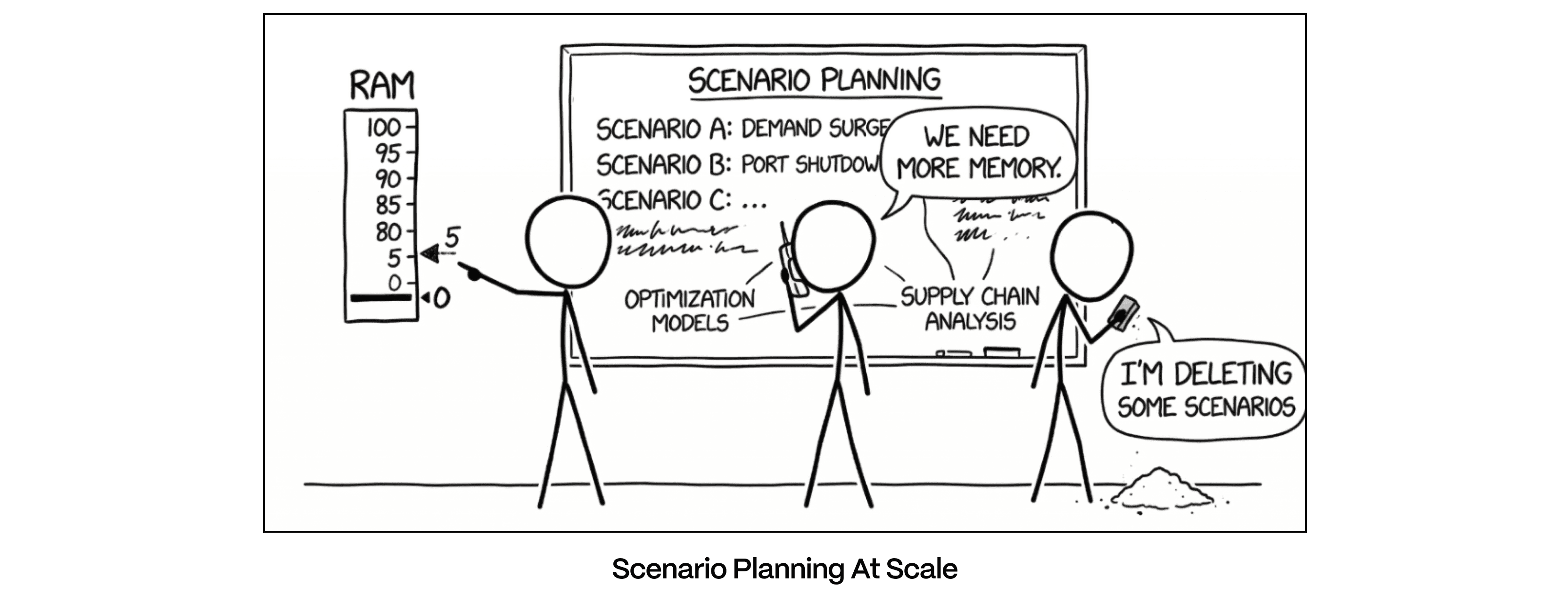
Most legacy planning and APM tools share a common architectural assumption: everything needs to live in memory. The entire working dataset — every SKU, every location, every time bucket — must fit in RAM for the system to perform.
This is what we call the in-memory tax.
When your dataset is small, you don't notice it. But as planning models grow — more granularity, more scenarios, more users — the tax comes due. You either pay enormous infrastructure costs to keep adding RAM, or performance degrades. Queries slow down. Scenario creation stalls. Users start waiting. Waiting kills decisions.
The in-memory tax limits model size, scenario count, user concurrency, and decision velocity. The infrastructure bill is just where it shows up first.
A Different Foundation: Two-Layer Architecture
The alternative decouples performance from memory size entirely. Instead of forcing everything into RAM, it uses two purpose-built layers working in concert.
Storage Layer: the durable home for all master data, built on a high-performance open table format designed for large-scale analytical workloads. The source of truth, always consistent, always complete.
Cache Layer: where speed lives. A disk-based columnar store with vectorized execution, it delivers sub-second query performance without requiring the dataset to fit in memory. When an application is built and deployed, only the tables relevant to that application are selectively loaded into the Cache Layer, not the entire dataset.
Between the Cache and the application sits the Semantic Layer, and it's doing more work than the name suggests. Every column in the data model is explicitly categorized as either an attribute (a dimension you slice and filter by) or a measure (a value you compute on). That categorization governs what gets loaded into Cache, how queries are structured, and what's exposed to the user. By the time someone opens the application, the data is already hot, pre-positioned and scoped for instant response, not pulled on demand.
Large workloads that would have crashed or stalled legacy systems run cleanly here.
The memory constraint is gone; the performance isn't.
Scenarios at Scale: Where Legacy Systems Break First
Scenario planning is where the in-memory tax hits hardest. Every new scenario in a traditional system is essentially a full copy of the dataset sitting in RAM. Five scenarios? Manageable. Fifty? You're burning through infrastructure. Five hundred? Forget it.
A modern architecture handles this through a hybrid copy strategy that plays to the strengths of each layer. In the Cache Layer, only the tables the application actually uses are physically copied from source to target scenario, strictly scoped to the application's footprint. In the Storage Layer, a zero-copy clone is created across the full dataset, nearly instantaneous and costing virtually no additional storage. Tables are shared between scenarios until an actual write occurs.
Scenario creation is fast and cheap. Edits in one scenario never affect another. The full dataset is always protected. Cache holds only what the app needs; Storage maintains the complete snapshot.
Multi-User Load Without the Shared Memory Problem
When dozens or hundreds of users are working simultaneously across scenarios, most systems start to buckle. The architecture prevents this through scenario-partitioned storage.
Every table in both Cache and Storage is partitioned by scenario. Each scenario is a first-class partition with full data isolation. Queries for one scenario never scan data belonging to another. A user works within a single active scenario at a time, eliminating conflicting writes or cross-scenario corruption.
As scenario count grows, query performance doesn't degrade. Each query stays scoped to its own slice of data. In legacy systems, every new scenario adds load to a shared memory pool, another manifestation of the in-memory tax that compounds with every user and every what-if.
Preventing Overload
Four design choices work together to prevent overload structurally rather than absorbing it with bigger hardware. At the data level, only the tables a specific application needs are loaded into Cache, so users are never competing for a single monolithic pool, and when new scenarios are created, the Storage Layer clones metadata pointers rather than data files, meaning I/O overhead grows only with actual data changes, not scenario count.
At the write level, saves flow from Cache to Storage asynchronously, insulating active query performance from background write operations. During a scenario run, saves to Storage are intentionally gated until the run completes, eliminating the I/O contention and race conditions that come from simultaneously serving an active compute run and absorbing a write for the same scenario.
The Bigger Picture: Open Architecture vs. Vendor Lock-In
There's a strategic dimension to this that goes beyond performance tuning.
Traditional planning systems are built on legacy, proprietary in-memory engines: closed systems that are slow to evolve, where innovation happens entirely at the vendor's discretion. The in-memory tax is a strategic dependency as much as a technical one. You're locked into a single vendor's roadmap, paying their price for every performance improvement.
A platform built on open-source technologies sits in a fundamentally different position. It benefits from a rapidly innovating ecosystem, a global community constantly pushing performance, scalability, and capability forward. Customers ride that momentum rather than waiting for a single vendor to prioritize their problem. That said, ecosystem innovation must be adopted deliberately, validated against real client use cases, tested for backward compatibility, and enabled only when it genuinely solves a problem worth solving.
The Bottom Line
Speed in planning is an architectural property, not a configuration option. The in-memory tax, the assumption that performance requires everything to live in RAM, constrains model size, scenario count, user concurrency, and decision velocity. Every year on a memory-bound system, that constraint compounds.
The architecture described here, two-layer storage, semantic scoping, hybrid scenario copies, partition-level isolation, and async write management, is what it looks like when speed and scale are engineered in from the start.
Get the architecture right. The fast decisions follow.
Read more
Planning & Forecasting
Supply Chain has a Multiverse Problem
Jul 17, 2026
Brian Dye
read more
Leadership & Decision Culture
The Counterpoint
May 27, 2026
Dinesh Natarajan
read more
Decision Intelligence
No Destination Stays Still
May 5, 2026
Brooke Collins & Sonja Jones
read more
Optimization Science & Modeling
Why Optimization Needs Simulation
Apr 14, 2026
Ratnaji Vanga
read more
Planning & Forecasting
Teaching Supply Plans to See Around Corners
Apr 6, 2026
Ugo Rosolia
read more
Planning & Forecasting
Why Your Planning Software is Holding You Back
Apr 1, 2026
Deb Mohanty
read more
Planning & Forecasting
Why Your Planning System Should Think Like a Perishable
Mar 23, 2026
Brian Howard Dye
read more
Planning & Forecasting
The Modeling-Planning Divide Was Always a Technology Problem
Mar 19, 2026
Vish Oza & Deb Mohanty
read more
Leadership & Decision Culture
The Innovation Tax: Why Your Best Work Doesn't Compound
Feb 18, 2026
Brittany Elder
read more
Leadership & Decision Culture
What Sudoku Teaches Us About Enterprise Software
Feb 17, 2026
Akshat Jain
read more
Decision Intelligence
Taming the Toughest Problems in Transportation
Dec 18, 2025
Amit Hooda & Priyesh Kumar
read more
Leadership & Decision Culture
Why 30% of Packaged Food Never Reaches a Consumer
Dec 22, 2025
Srivatsan Kadambi Seshadri & Thilak Satya Sree
read more
Leadership & Decision Culture
How to Plan When Nothing Goes According to Plan
Dec 15, 2025
Dr. Nilendra Singh Pawar
read more
Architecture & Composability
Why We Fall Back to Heuristics
Nov 24, 2025
Frank Corrigan
read more
Architecture & Composability
What You Group is What You See
Nov 3, 2025
Frank Corrigan
read more
Architecture & Composability
The Cost of Curiosity
Sep 24, 2025
Brooke Collins
read more
Leadership & Decision Culture
Lyric Named a 2025 Gartner® Cool Vendor in Cross-Functional Supply Chain Technology
Sep 2, 2025
Sara Hoormann
read more
Leadership & Decision Culture
Built for Builders. Backed to Scale.
Aug 5, 2025
Ganesh Ramakrishna
read more
Architecture & Composability
Generative AI meets Time Series Forecasting
May 2, 2025
Deb Mohanty
read more
Architecture & Composability
The Dying Art of Supply Chain Modeling
Apr 15, 2025
Milind Kanetkar
read more
Leadership & Decision Culture
Tariffs, Trade Wars, and the AI Advantage: Why Fast Modeling Wins
Apr 7, 2025
Lyric Team | Prime Contributors - Laura Carpenter, Victoria Richmond, Saurav Sahay
read more
Architecture & Composability
Lyric Leverages NVIDIA cuOpt to Elevate Supply Chain AI
Mar 18, 2025
Sara Hoormann
read more
Architecture & Composability
The Technology Behind Modeling at Scale
Mar 14, 2025
Ganesh Ramakrishna
read more
Leadership & Decision Culture
Our Dream is to Make Every Supply Chain AI-First
Oct 18, 2023
Ganesh Ramakrishna
read more
Architecture & Composability
What Is a Feature Store Anyway?
Mar 14, 2024
Sara Hoormann
read more
Leadership & Decision Culture
Supply Chain AI Ain’t Easy
Feb 20, 2023
Ganesh Ramakrishna & Sara Hoormann
read more
Decision Intelligence
Four Ways to Improve Supply Chain Operations with Machine Learning
Jan 26, 2023
Vish Oza
read more
Architecture & Composability
Prediction is the New Visualization
May 30, 2024
Frank Corrigan
read more