Planning & Forecasting
Supply Chain has a Multiverse Problem
AUTHOR
Brian Dye

Supply chain software had a multiverse long before Hollywood decided every superhero needed one.
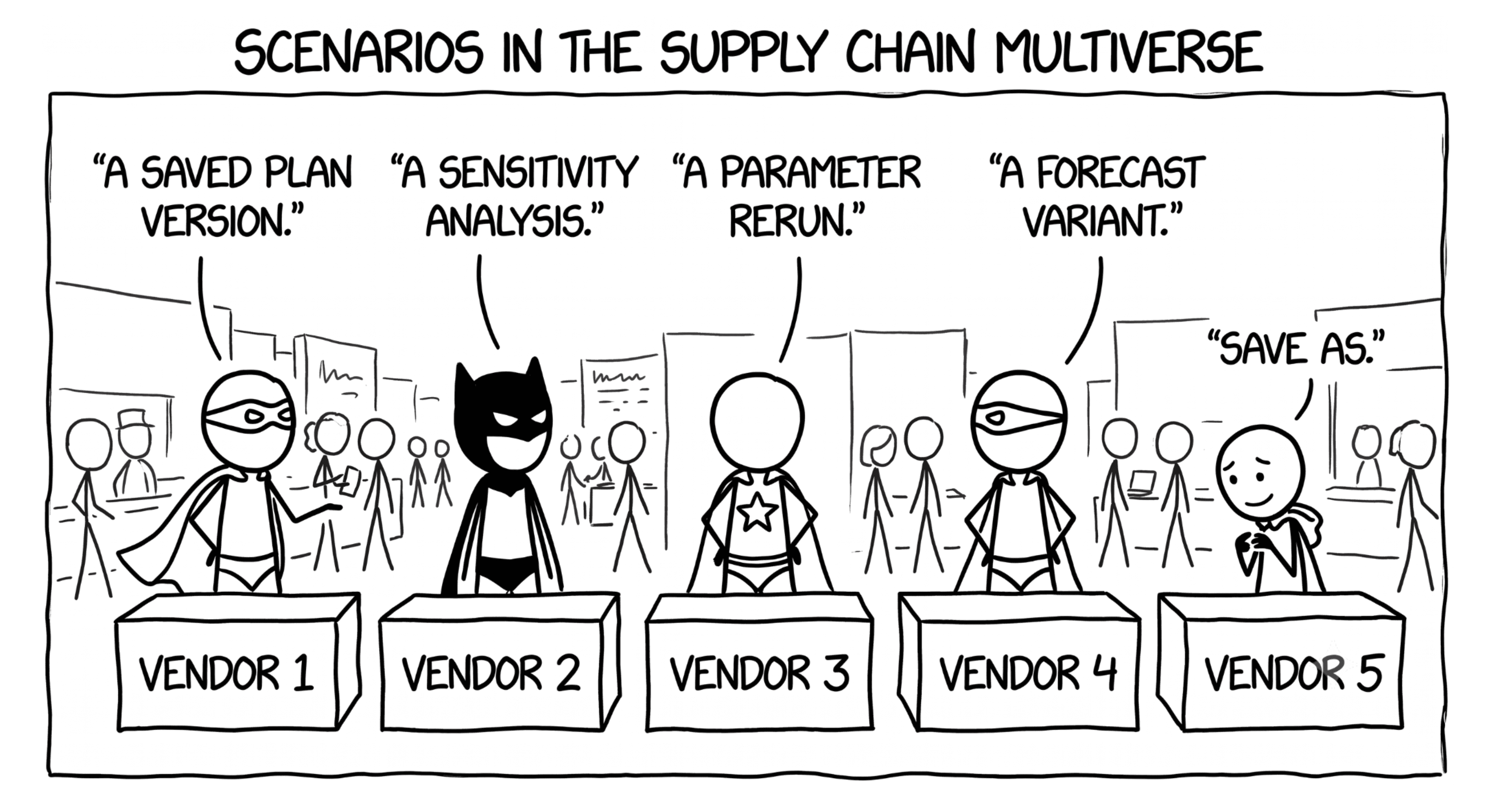
We call them scenarios. Ask five vendors what that means and you may get seven answers.
For one, it's a saved version of a plan. For another, it's a sensitivity analysis. Somewhere else, it means changing a parameter, rerunning a model, and comparing the result. Sometimes, if we're being generous, it's basically "Save As" wearing a supply chain badge.
None of those definitions are necessarily wrong. That's part of the problem.
Supply chain teams use scenarios for different jobs. Sometimes they're managing the normal evolution of a plan. Other times they're asking a different question about the future.
Either way, you end up with multiple versions of reality. But the business can only run on one.
Sometimes a scenario is a version of the plan
However a team divides planning responsibility, by category, customer, supplier, or region, the common thread is that multiple people work from a shared starting point. Responsibilities may be separate or overlap, but eventually that work has to become a plan the business can use.
That's a scenario problem too.
Planning is rarely as simple as "Alice edits first, then Bob gets a turn." People work in parallel, start with different assumptions, and occasionally change the same thing in two perfectly reasonable ways.
Supply chains, unfortunately, have not agreed to become less complicated for the convenience of our software.
Sometimes a scenario really is a what-if
The other meaning of scenario is probably the more familiar one.
What if demand increases by 8 percent? What if transportation costs rise by 15 percent? What if we close a distribution center, add capacity somewhere else, change a sourcing policy, or shift volume between suppliers?
These questions are exploratory. You're deliberately changing assumptions, parameters, constraints, or inputs to see what happens next. You're rarely asking just one, either. Real planning means what-ifs at scale: dozens or hundreds of runs to find the handful that matter.
Software often treats these two worlds differently. Operational versions of a plan live in one construct; strategic experiments live somewhere else.
In Lyric Studio, we think about them as variations of the same underlying idea. A scenario can represent a working version of a plan or a deliberate what-if. The purpose changes, but teams don't need an entirely different mental model just because the question changed.
Creating scenarios is easy. Reconciling them is harder.
Most scenario conversations focus on creation: make a copy, change something, run it, compare the result.
Creating another version of a plan is rarely the hard part. Give us enough time and we'll create dozens, usually with names like "Final," "Final_v2," and "Final_v2_USE_THIS_ONE."
Suppose planners create scenarios around product lines, customers, suppliers, or geographies. Eventually, some of that work needs to come back together.
Lyric Studio merges scenarios back together. Pull in one change, a handful, or everything a colleague did. When two scenarios disagree, the conflict shows up on screen instead of vanishing into whichever version happened to be saved last, and a person decides which change wins with both options in front of them.
That matters because two scenarios can both be valid and still disagree. Say Alice raises the forecast on a product family after a customer call. That same afternoon, Bob caps supply on the same SKUs because a supplier flagged a constraint. Both changes are reasonable. Both cannot be chosen.
Declaring one scenario "the latest" hides the decision without resolving it.
The software should make that conflict visible and let people resolve it deliberately.
Collaboration without copying the world
Supply chain models can be large. Very large. Creating full physical copies every time someone explores an idea gets expensive and cumbersome quickly.
Lyric Studio uses a zero-copy approach to scenarios. Creating a scenario doesn't require duplicating the full underlying dataset. Instead, scenarios remain lightweight as users make changes.
That makes collaboration practical at scale, without every new branch of thought requiring another full copy of the world.
Changes are also tracked for auditability, so there’s a record of how the plan evolved and who contributed to it.
Beyond the what-if
What matters is whether a platform can support the way people actually work: sometimes together, sometimes independently, and sometimes making changes that don't agree.
So the next time a vendor says their platform "supports scenarios," ask for receipts. The phrase covers everything from "Save As" to a real reconciliation engine. Here's what to check:
Both kinds of scenarios. Can it treat a scenario as a working version of the plan, built in parallel from a shared starting point, and as a deliberate what-if, where you change assumptions to see what breaks? A platform that only does one is solving half your problem.
A path from what-if to plan. When an experiment proves out, can it graduate into the working plan, or does someone rebuild it by hand and hope nothing gets lost?
Cheap creation. Does spinning up a scenario copy the whole dataset, or stay lightweight? If every branch is expensive, exploration gets rationed.
Solo and shared commits. Can one person commit their own work without stepping on a colleague's, and can the team commit to a shared version when that's the right call? Both are legitimate. Forcing one is forcing a workflow.
An audit trail. When a plan turns out wrong, the first question is who changed what and when. If the platform can't answer that, you're planning on faith.
AI that carries real scenario work. Can an agent propose the scenarios worth running and explain conflicts in plain language, or does it only fill in a cell? One of those changes how a planner spends the day.
Every multiverse story ends the same way. Sooner or later, someone has to collapse the timelines back into one.
Creating alternate realities is easy. Getting everyone back to one universe is the hard part.
Now you know what to ask.
Read more
Leadership & Decision Culture
The Counterpoint
May 27, 2026
Dinesh Natarajan
read more
Decision Intelligence
No Destination Stays Still
May 5, 2026
Brooke Collins & Sonja Jones
read more
Optimization Science & Modeling
Why Optimization Needs Simulation
Apr 14, 2026
Ratnaji Vanga
read more
Engineering Insights
The Real Reason Your Planning System Slows Down
Apr 13, 2026
Aditya Jaroli & Pradeep Vijayakumar
read more
Planning & Forecasting
Teaching Supply Plans to See Around Corners
Apr 6, 2026
Ugo Rosolia
read more
Planning & Forecasting
Why Your Planning Software is Holding You Back
Apr 1, 2026
Deb Mohanty
read more
Planning & Forecasting
Why Your Planning System Should Think Like a Perishable
Mar 23, 2026
Brian Howard Dye
read more
Planning & Forecasting
The Modeling-Planning Divide Was Always a Technology Problem
Mar 19, 2026
Vish Oza & Deb Mohanty
read more
Leadership & Decision Culture
The Innovation Tax: Why Your Best Work Doesn't Compound
Feb 18, 2026
Brittany Elder
read more
Leadership & Decision Culture
What Sudoku Teaches Us About Enterprise Software
Feb 17, 2026
Akshat Jain
read more
Decision Intelligence
Taming the Toughest Problems in Transportation
Dec 18, 2025
Amit Hooda & Priyesh Kumar
read more
Leadership & Decision Culture
Why 30% of Packaged Food Never Reaches a Consumer
Dec 22, 2025
Srivatsan Kadambi Seshadri & Thilak Satya Sree
read more
Leadership & Decision Culture
How to Plan When Nothing Goes According to Plan
Dec 15, 2025
Dr. Nilendra Singh Pawar
read more
Architecture & Composability
Why We Fall Back to Heuristics
Nov 24, 2025
Frank Corrigan
read more
Architecture & Composability
What You Group is What You See
Nov 3, 2025
Frank Corrigan
read more
Architecture & Composability
The Cost of Curiosity
Sep 24, 2025
Brooke Collins
read more
Leadership & Decision Culture
Lyric Named a 2025 Gartner® Cool Vendor in Cross-Functional Supply Chain Technology
Sep 2, 2025
Sara Hoormann
read more
Leadership & Decision Culture
Built for Builders. Backed to Scale.
Aug 5, 2025
Ganesh Ramakrishna
read more
Architecture & Composability
Generative AI meets Time Series Forecasting
May 2, 2025
Deb Mohanty
read more
Architecture & Composability
The Dying Art of Supply Chain Modeling
Apr 15, 2025
Milind Kanetkar
read more
Leadership & Decision Culture
Tariffs, Trade Wars, and the AI Advantage: Why Fast Modeling Wins
Apr 7, 2025
Lyric Team | Prime Contributors - Laura Carpenter, Victoria Richmond, Saurav Sahay
read more
Architecture & Composability
Lyric Leverages NVIDIA cuOpt to Elevate Supply Chain AI
Mar 18, 2025
Sara Hoormann
read more
Architecture & Composability
The Technology Behind Modeling at Scale
Mar 14, 2025
Ganesh Ramakrishna
read more
Leadership & Decision Culture
Our Dream is to Make Every Supply Chain AI-First
Oct 18, 2023
Ganesh Ramakrishna
read more
Architecture & Composability
What Is a Feature Store Anyway?
Mar 14, 2024
Sara Hoormann
read more
Leadership & Decision Culture
Supply Chain AI Ain’t Easy
Feb 20, 2023
Ganesh Ramakrishna & Sara Hoormann
read more
Decision Intelligence
Four Ways to Improve Supply Chain Operations with Machine Learning
Jan 26, 2023
Vish Oza
read more
Architecture & Composability
Prediction is the New Visualization
May 30, 2024
Frank Corrigan
read more