The First Supply Chain Engineer I Ever Met
TABLE OF CONTENT
SHARE THIS POST
You are not short of analysts, data scientists, or decision-makers. You are short of the person who makes their work add up to a better decision. That person used to appear by luck. Here is how to build one instead.
In November 2018 I was working in last mile transportation at Target. Peak season. The six weeks when a retailer finds out what it is actually capable of.
Every morning through peak, a colleague named Alex Meyer, who would later work with me again at Lyric, ran our daily last mile transportation review. He stood in front of the room and accounted for carrier performance: what had gone wrong overnight, why, and what we were doing about it.
He needed better answers than his reporting could give. So he built them.
He wired together internal Target systems and third-party carrier APIs. He pulled in warehouse backlog, warehouse productivity, and order backlog; none belonged to transportation, all determined whether transportation hit its numbers. He built the prediction models. He wrote the algorithms himself. Validated the data transformations. The tool did not just show where we were failing. It showed where we were about to fail.
Every morning of the hardest weeks of the year, he turned up with a new version.
By mid-peak it was not only running his review. It had a standing slot in the supply chain organization's daily business review; the one the CSCO and full VP team held every morning of the season. One of the more senior, harder-to-impress people in that room called it next level stuff.
I had no word for what Meyer was at the time. I do now. He was a supply chain engineer, eight years before the title meant anything.
He was also, in 2018, a unicorn. The reason is sitting in that description, if you read it again.
What it cost to be one
He had to build all of it himself.
Nothing supplied the science, the connections, the forecasting models, or the front end. So the job required one person who could do the systems thinking, the data engineering, the modeling, and the building of the thing people actually opened, simultaneously, at pace, during the worst weeks of the year. That is four disciplines, and most people have one.
Which is why an organization got about one Meyer, if any, and got him by accident. You could not hire for it; the job description would read like a fantasy. You could not train for it. You waited to see whether someone turned up.
That constraint is the thing that has changed.
Three of the four things Meyer did were construction. The connections he hand-wired get configured now rather than coded. The forecasting and algorithms he wrote come pre-built, validated, and maintained. The application he built gets assembled, without a front-end engineer. You still have to know which model belongs on which problem and how supply chain data lies. But you no longer have to be the person who could have written any of it from scratch.
The fourth thing was never construction. It was knowing which decision to point all of it at, and standing in a room every morning making sure the answer got used. Nothing has made that easier.
I am not alone here. Lora Cecere has argued for a supply chain engineer, and Peter Bolstorff, who helped write the SCOR standard, found a client's biggest gap was the coordinating work between functions. Their versions run wider than mine. The scarcity is the same.
The part that's left
Knowing which decision matters. Knowing whether the answer in front of you is right. Knowing how to put it somewhere it will actually get used.
That is the job. Analysts build spreadsheets. Data scientists build models. Decision-makers go to meetings. Supply chain engineers build the thing that turns data into a decision: an application a planner opens, or a pipeline that writes the answer straight into the ERP. They celebrate when a decision runs ten times faster, a week of spreadsheets closing in an afternoon, and closing better.
Meyer wrote his own algorithms because he had no choice. The 2026 version of the role has one: the platform supplies the science, and the work is choosing the right pieces, chaining them, and wiring the outcome back into the decision. The other half is translation: turning what the business values into objective functions the math can solve for. Custom work goes to a data scientist. Most days go to the people who make the decision, and to landing the right answer at the moment they decide.
Four capabilities carry it. Meyer's tool has all four.
Systems intuition. He pulled warehouse and order backlog into a transportation tool because that is where transportation's numbers were being decided: seeing how one decision drives the next, and where a local metric betrays the global objective.
Comfort in the data layer. Internal systems, third-party APIs, and the ways supply chain data misleads. Stockouts censor demand, so sales understate what customers wanted.
Fluency with the toolbox. Knowing when to reach for exact optimization, a heuristic, simulation, forecasting, ML; what each expresses, where it breaks, how to read what comes out. The bar is fluency rather than authorship.
Product sense. The one people skip, and the one that made Meyer's work matter. A model nobody opens is worth nothing. His never had an adoption problem: he was the user, he owned the number, and the loop from question to change was one person long. The measure is adoption, and whether the decision got better.
A fifth is arriving quickly: working fluently with agents. What to hand one, how to check what comes back, and where it has no business being. It is not table stakes yet. It will be.
Start with the seam you already own
A supply chain is one continuous decision process, carved up in practice and handed to teams measured on their own slices. Money does not leak inside the silos. It leaks at the seams between them. But a seam belongs to nobody; run transportation and you can agree with every word and correctly conclude it is not your problem.
Meyer's answer is better than the argument. He had no cross-functional mandate. He sat inside last mile, owned a last mile number, and reached upstream into warehouse and orders because that is where his number was being decided. He closed a seam from one side.
That is the version you can fund on a Tuesday. Find the handoff that determines your metric and that you currently receive as weather. Put someone on it. The cross-functional seams are worth more, and they come second, once somebody has done it once and a leader has watched the number move.
You don't wait for this person anymore
You are not short of analysts, data scientists, or decision-makers. You are short of accountability for whether their work adds up to a decision that got better.
Start with one person. That is what the story shows, and it needs no reorganization or headcount request. Find whoever owns a number and cannot get a good enough answer to defend it. Give them the ability to build, and the standing to change what they built between reviews. Leave them where they are: on the team that owns the decision, working to its clock, rather than in a central function fielding requests.
Meyer's tool worked because the person who owed the answer each morning could change the tool that afternoon. That is an arrangement, and most organizations get it wrong by separating the people who own a number from the people permitted to build. A builder who raises a ticket to learn what the business wants produces something plausible and unused. It is the cheapest item on this list and the most often skipped.
Then get a second one.
This part surprised us, and we now see it everywhere. One supply chain engineer is an accelerant. Two compound. They take on different problems, pressure-test each other's work before anyone senior sees it, and neither solves anything alone. It also stops the whole thing being a personality: one is how Meyer works; two is how the company works, and it survives either of them leaving.
The pair should not be symmetrical. People arrive with a spike: a modeler with strategic range and no feel for execution planning, a planner with sharp instincts for what a tool should do who has never built one, a data scientist who can do anything with a dataset and has never stood in a distribution center. Two different spikes side by side cover ground neither could alone. Each needs enough of the other's areas to hand work across cleanly; skip that and you have rebuilt the silos inside your own team. Depth can be distributed. Literacy cannot.
Beyond two you are building a team, and Meyer stops being the template; 2018 gave him no alternative. Audit your people against the four capabilities, recruit against the gaps, and give the group one charter that eventually runs as wide as the decisions you want to move. Supply chain engineering is closer to a charter than a job title.
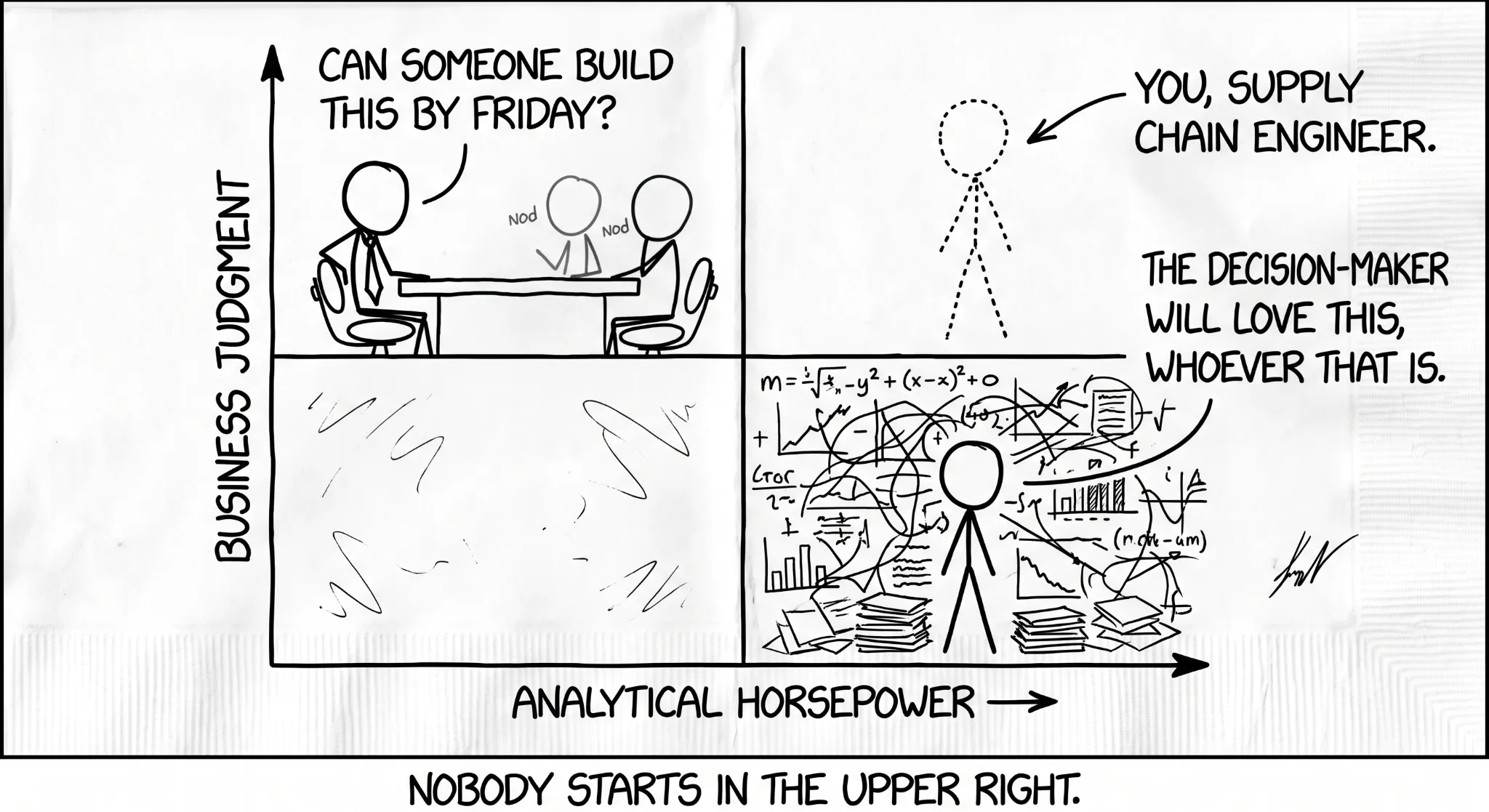
The map fits on a napkin: analytical horsepower on one axis, business judgment on the other. Most practitioners are deep on one and thin on the other. The supply chain engineer is the upper right: enough rigor to build the thing, enough judgment to know it is the right thing, enough proximity to get it adopted.
Nobody starts in the upper right. They move toward it from a corner.
That climb is why we built Crescendo, Lyric's cohort program for practitioners: it takes people deep in one corner and builds the other.
In 2018, you waited for a Meyer to turn up.
In 2026, you build one.
Curated Articles
%201.webp)


Deliver Better Decisions Faster
Supply chains run on thousands of interconnected decisions. Demand shapes production. Inventory affects transportation. Every choice influences another. Every decision matters.