The Agentic Era of Control Towers

TABLE OF CONTENT
SHARE THIS POST
Imagine having Tony Stark’s JARVIS on your planning team. It works around the clock, handles disruptions and routine fixes as they come up, and brings you in only when a decision needs your judgment. Sounds like science fiction, but agents are making it real.
Control towers have been around in supply chains for decades, but most still stop at showing you the problem, not its impact or what to do about it. In the past year, agentic AI has taken a giant leap forward. Pair the agents with math (algorithms), and it changes what control towers can do. Here’s where control towers started, and where they go next.
How we got here
The first generation put every system on one dashboard, from the ERP to warehouse, transport and supplier data. Everyone finally saw the same numbers, but deciding what to do was still the planners’ job. They stitched the reports together, sized up the impact and tested a few fixes, each needing a yes from another team before anything was final.
The second generation added alerts and rules, e.g. if a carrier rejects a load, switch to the backup. But every supply chain had its own rules, and every rule had exceptions, so the list kept growing. Even after thousands of layered rules, disruptions still arrive that none of them cover, usually late on a Friday.
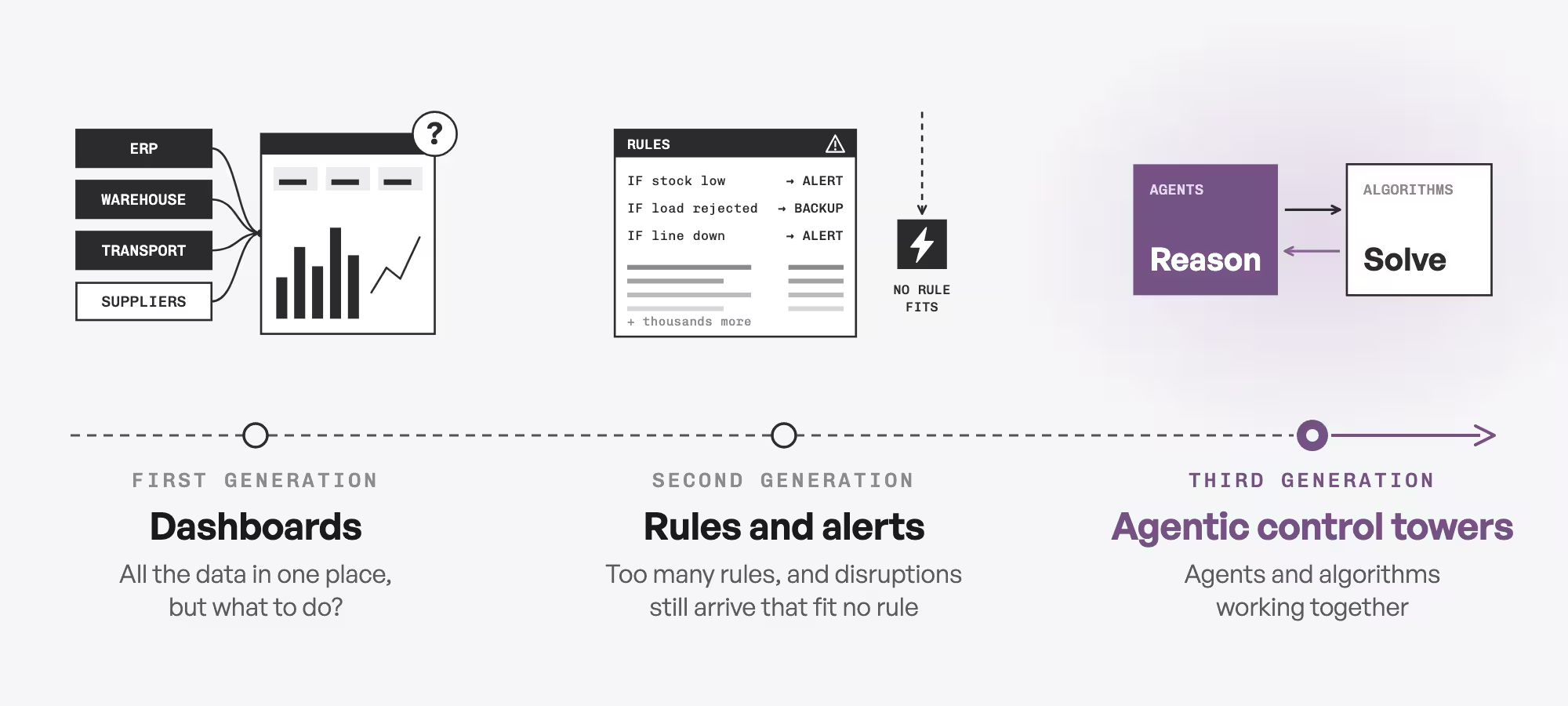
The planner’s week, before and after agents
Picture a supply planner’s week. On Monday the data refreshes, and the planner checks stock and spots problems weeks out. By midweek the plan has moved into spreadsheets, because the planning system is too slow and rigid to keep up with each round of changes and model all the complexity. The versions pile up, from plan_v9.xlsx to plan_v26_FINAL_reviewed.xlsx, and by Friday afternoon there is a plan.
Then on Friday evening, four surprises arrive at once. The plant line is down until next Thursday. A big order has come in that the warehouse can’t fully cover. The carrier has no extra trucks for promo week. A competitor’s promotion is already running. The only option left is a weekend of calls, emails and spreadsheet workarounds, so that by Monday there is something that works.
Now picture the week as it should go. Agents are always on, watching stock, orders, plant output and weather. At 6:10 on Saturday morning, a plant reports that line 2 is down for two weeks. Before anyone is awake, the agents have a plan that moves the volume to two other plants, checked for crews, materials, trucks and stock cover. One thing falls outside their guardrails, so they send it for approval. On Sunday a hurricane warning goes out for the Gulf Coast, and the agents pull shipments forward and move supply to other parts of the network on their own.
On Monday morning, the planner reviews the agents’ analysis and approves the plan before noon. For the rest of the week, the agents handle the everyday fixes and ask the planner only when a fix goes beyond their authority, e.g. a rush order that would take stock another warehouse is holding for its own customers.

Agents and algorithms working as a team
What makes that week possible is a combination of reasoning (agents) and math (algorithms). A rule can only do what someone wrote down in advance. An agent can reason through a situation nobody planned for: read a signal it has never seen, work out what it means and explain its thinking in plain words.
Reasoning alone can’t solve the problem, though. Every supply chain is a giant puzzle of products, plants, trucks and limits, and finding the best answer to it takes math. That is what algorithms do. The answer comes from precise math, so it can actually be executed, with every plant, order and truck updated together. The agent frames the problem, the algorithms solve it, and the agent brings the answer back to the planner.
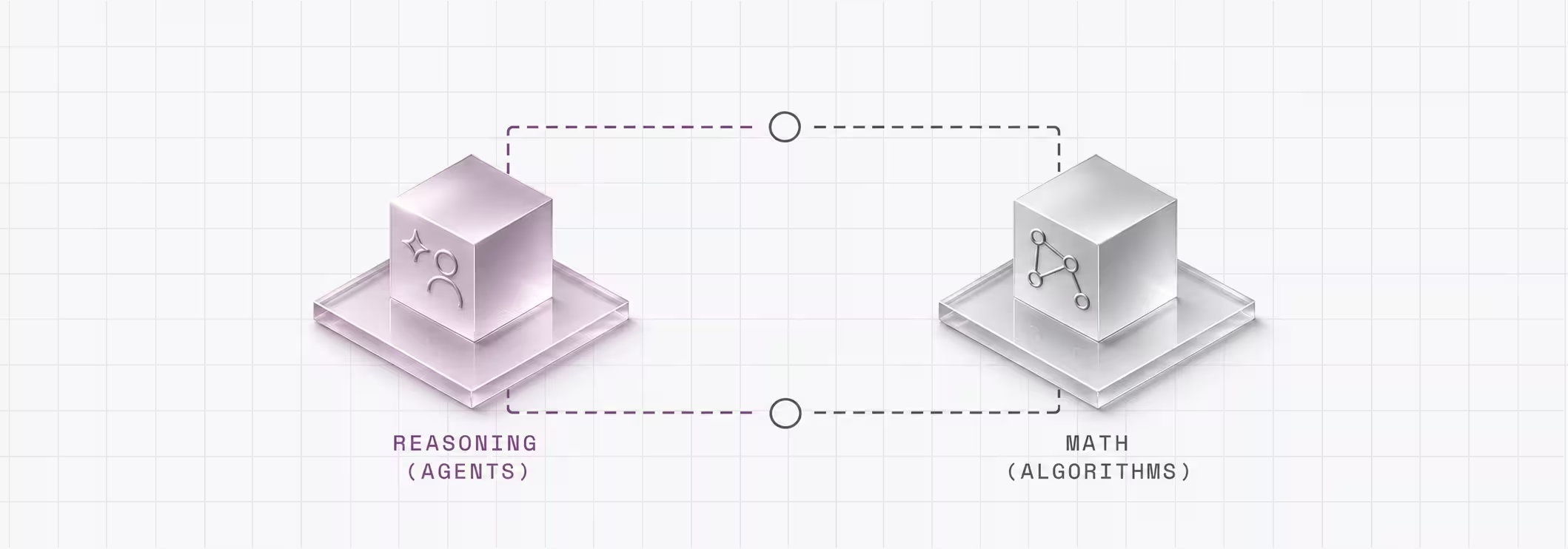
For example, when line 2 went down on Saturday, an agent read the plant’s message alongside open orders, stock and capacity, and worked out which orders, products and customers were hit, and when. An algorithm built the best supply plan for the two-week repair. The agent chose other scenarios to test, e.g. the repair taking three weeks instead of two, demand coming in higher than forecast, or another plant falling behind. The algorithm solved each one, and the agent compared the plans and recommended the one that held up best.
Speed matters just as much. An algorithm that takes all night to run is no help when a line goes down at 6:10 on a Saturday. The answer has to come back while there is still time to act, before a late order turns into rush freight or an empty shelf.
Planners stop firefighting and start deciding
Why did the line 2 plan land in the planner’s inbox while the hurricane response didn’t? Because its extra cost went past the guardrails the planner had set, and the hurricane move stayed inside them. When an agent does ask, it shows the impact if nothing is done, the possible fixes, the one it recommends and why.
Sometimes the planner knows something the agent doesn’t. Say the agent wants to move volume to a plant whose spare line is promised for next month’s launch. The planner picks another fix, notes why, and the agent remembers it for similar calls in the future. Every call, the planner’s or the agent’s, is saved with the reason behind it, so the team’s know-how is recorded for everyone to use, rather than sitting in a few people’s heads.

With the routine work off their desks, planners finally get to the questions that keep slipping to next quarter: how much to pre-build before summer without stock expiring, or when to switch to new packaging without writing off the old.
Where Lyric places its bet
Every vendor now shows agents, but agents are only the tip of the iceberg. Underneath, they need algorithms that solve supply chain problems precisely and a common view of the data and the business. Our bet is on agents and algorithms working as one team, each doing what it does best. We built Lyric Studio for exactly this: one AI-native platform where agents and algorithms work from that common view of the data and the business. This is what sets us apart from legacy vendors, which can only bolt agents on top of a fixed application.
For two generations, control towers helped planners see problems. The next generation works through those problems with them, and we are only at the start. The test for any control tower is simple: what happens when the surprises land on a Friday evening.
Sara Hoormann, Stijn-Pieter van Houten and Ganesh Ramakrishna went further into this in our webinar, Signal to Decision: AI-Native Planning Through Any Disruption, with a product demo and live audience questions. Watch the conversation here.
Curated Articles
Deliver Better Decisions Faster
Supply chains run on thousands of interconnected decisions. Demand shapes production. Inventory affects transportation. Every choice influences another. Every decision matters.