Architecture & Composability
Why We Fall Back to Heuristics
AUTHOR
Frank Corrigan
What’s a Heuristic in Supply Chain Problem-Solving?
A heuristic is like a street-smart shortcut your supply chain takes when the perfect answer would take way too long to calculate.
Instead of crunching every possible number, a heuristic says: “I don’t need perfection — I need something good fast.”
In supply chain terms, it’s a practical rule of thumb that helps you make solid decisions when you’re juggling trucks, warehouses, inventory, and deadlines, without melting your brain (or your computer). Think of it as a clever hack for messy logistics puzzles.
If you’re talking inventory with anyone in supply chain, there’s one heuristic that instantly makes you sound competent: ABC analysis.
A simple idea from the mid-20th century; rank products by revenue, set a basic service level, and move on. It’s a quick way to decide how to carefully manage each item.
Interestingly enough, this simple approach still runs billion-dollar supply chain networks in 2025.
With all our data, machine learning, AI and compute power…
Why does a 70-year-old shortcut still dominate the conversation?
Setting Up The Experiment
To play with the idea, I built a small experiment:
1,000 fake products with realistic demand, lead times, and costs.
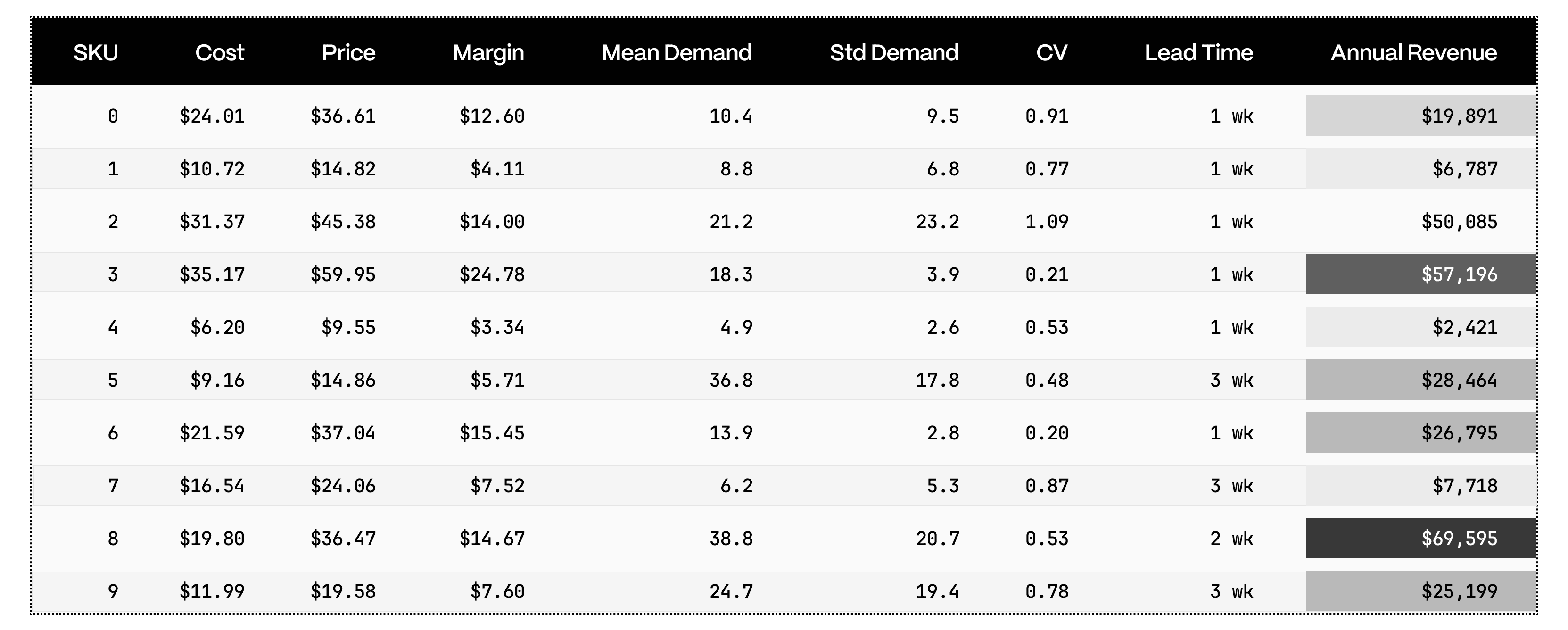
Then I compared two approaches:
ABC analysis heuristic: Top 20% of products by revenue get a 99% service level, the middle 30% get 95%, the rest 90%.
SKU-level optimization: Newsvendor is a math problem solved for ordering just enough so that your chance of selling out is perfectly balanced with your fear of leftovers. In this method, I use the Newsvendor formula to pick an “optimal” service level for each individual SKU which balances holding cost (0.25 annual carry rate) against stockout cost (set to 2× the product margin).
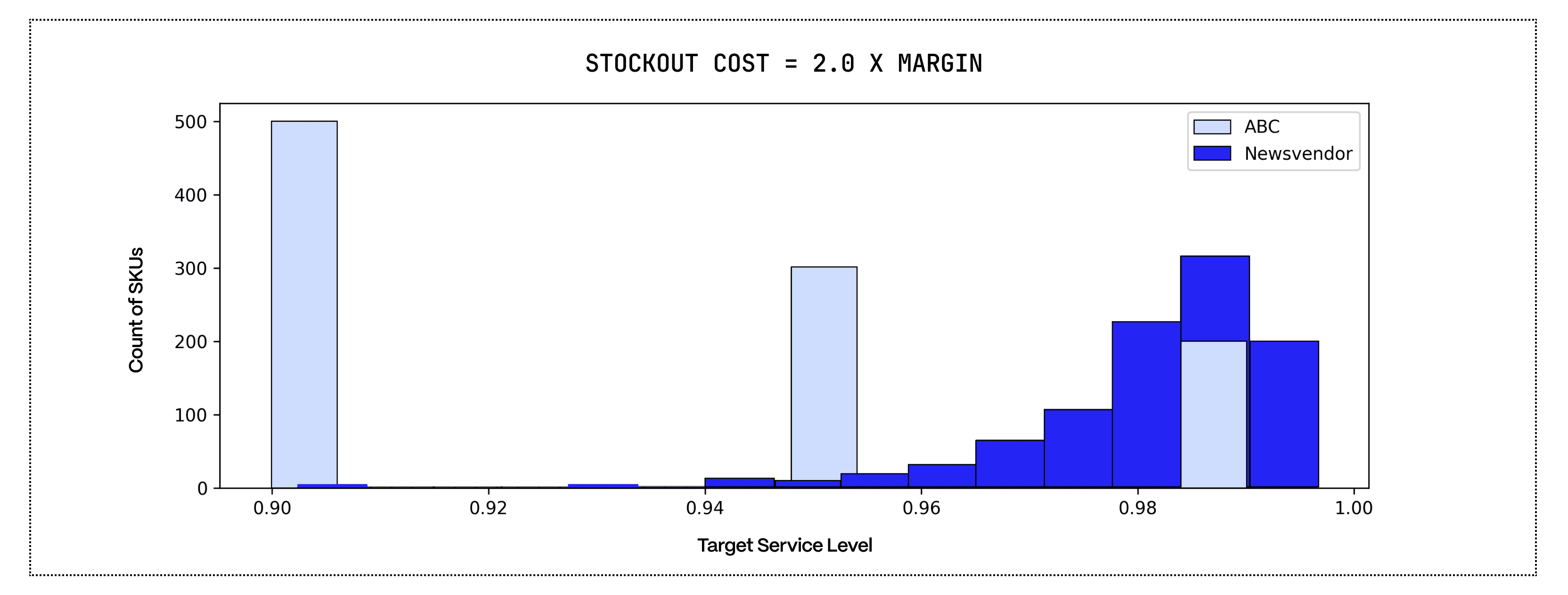
I expected SKU-level optimization to hold less inventory, raise service levels, and reduce total cost.
It did.
Newsvendor Wins!
The Newsvendor approach didn’t just edge out ABC; it crushed it.
Higher service levels. Roughly 60% lower total cost.
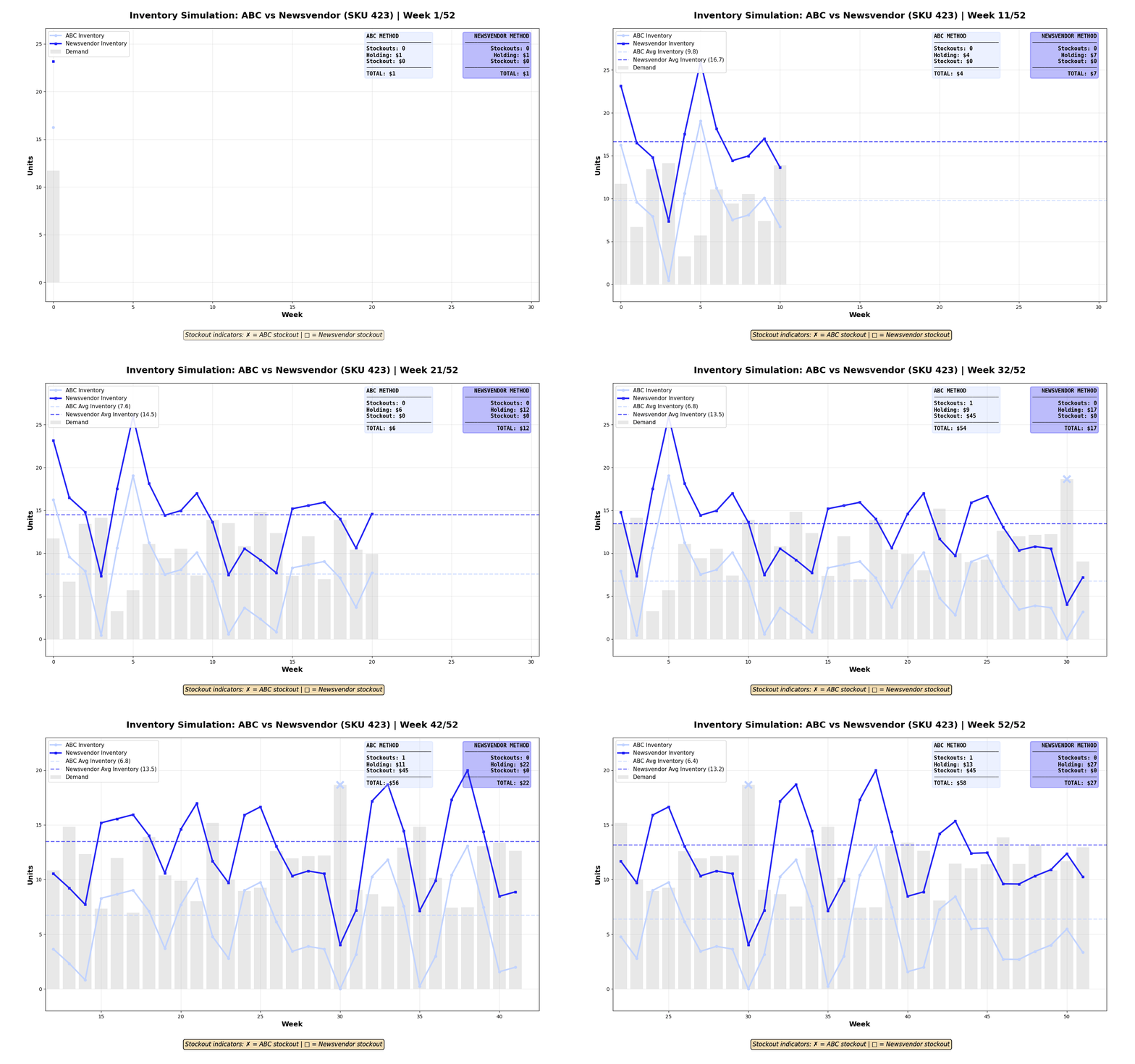
A single example GIF below shows the pattern:
Newsvendor carries a bit more inventory; costlier than ABC.
ABC hits a stockout around Week 30.
That one miss reverses ABC’s cost advantage.
Service levels: 100% for Newsvendor, 98% for ABC.
Newsvendor has lower overall cost and better service level.
Huge Problem Though…
Those inputs I used
(a 0.25 carrying cost and a stockout cost set to 2× margin for all products)
are broad assumptions.
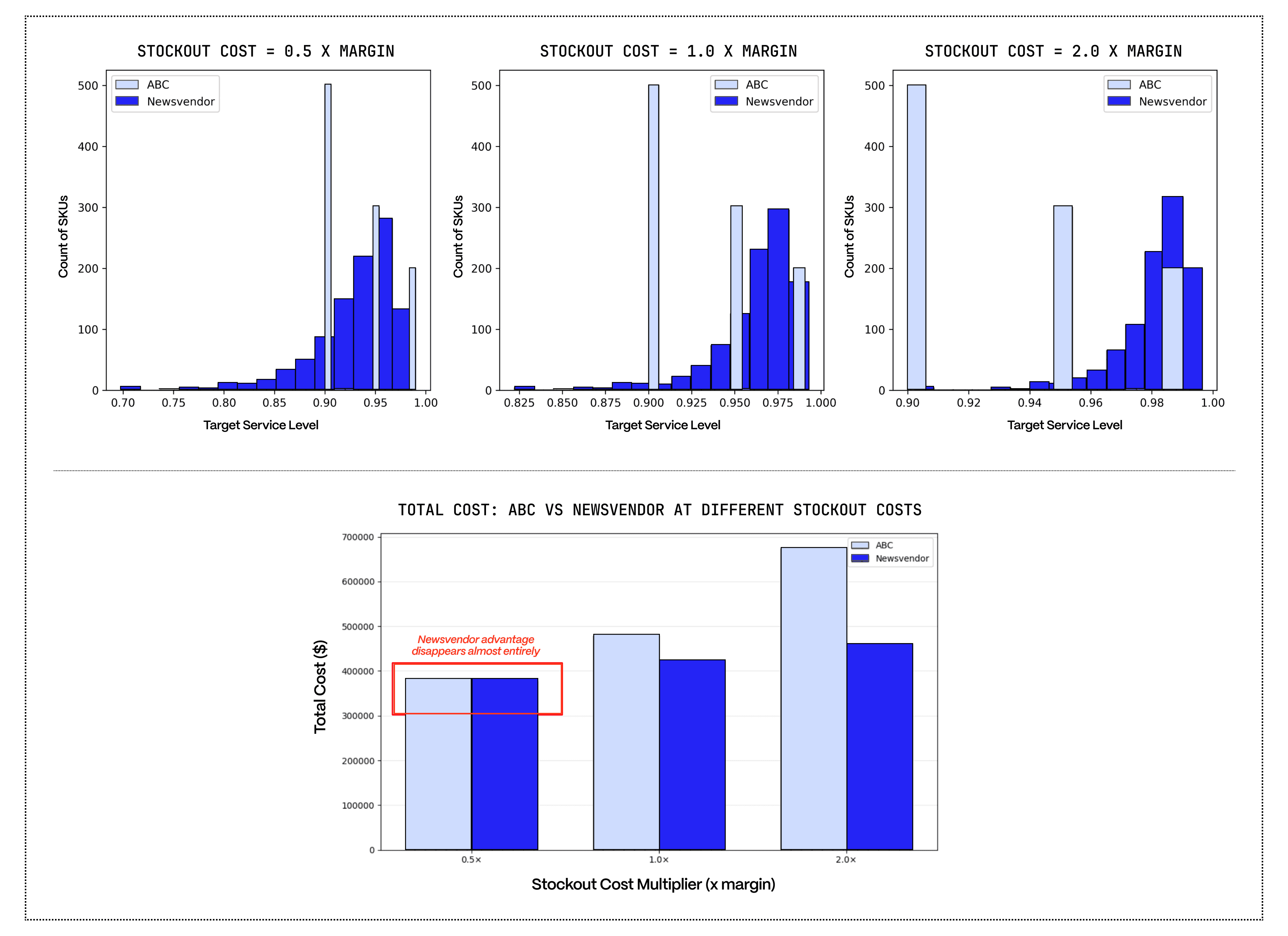
If I change the stockout cost assumption, the SKU-level advantage shrinks.
If I change it enough, it disappears entirely.
We Just Need to Correctly Estimate Stockout Cost Right?
Researchers have tried.
The work is clever, careful, and deeply specific to each setting.
You can get a number.
It’s just rarely the number.
In one business, a stockout creates a $13 short-run loss and a small long-run dip.¹
In another, it depends entirely on whether a near-perfect substitute sits two inches to the right.²
Online, it shifts with delivery speed, transparency, promotions, and even the mood of the checkout fee.³
The methods are heavy. Event studies after stockouts, survival models for repeat purchase, MDCEV and choice models for substitution.
And they all drift over time.
Once you estimate it, you have to maintain it.
New promos. New packaging. New competitors. New SLAs.
Your beautifully calibrated number starts aging immediately.
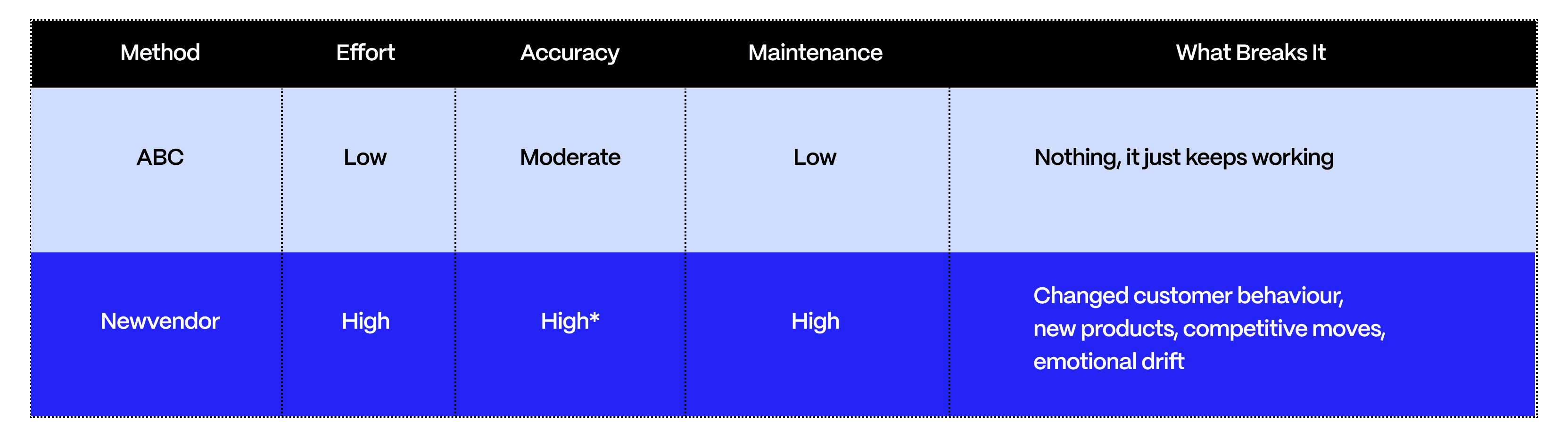
So yes, you can build a better engine than ABC.
But it needs careful fuel and regular maintenance.
Most teams don’t have that budget; time, data, or attention.
Meanwhile, ABC runs on autopilot.If the goal is simply to get in the ballpark, ABC gives you most of the value for a fraction of the effort.
Why We Fall Back on Heuristics
Heuristics stick around because they’re light.
You pick them up, use them, and keep moving.
Reading those papers on stockout-cost estimation, you can feel the weight of it all.
Data, modeling, re-estimation, drift.
It’s simply too much.
Suddenly the “better” method feels heavier than the problem you were trying to solve.
Heuristics survive because they’re cognitively efficient.⁴
They give you an answer quickly enough that you can keep moving.
The point isn’t “don’t try to be precise.”
It’s that precision only wins when its marginal benefit exceeds its marginal cost.
The interesting question becomes:
What would have to be true for a precise method to honestly be worth it?
The decision to use them would need to be as light as the heuristic itself.
In inventory management, we're not there yet. So conversations drift back to ABC.
ATTRIBUTION
¹ https://www.kellogg.northwestern.edu/faculty/anderson_e/htm/personalpage_files/Papers/Measuring_and_Mitigating_the_Costs_of_Stockouts.pdf
² https://www.dii.uchile.cl/~amusalem/OOS%20paper%202010.pdf
³ https://papers.ssrn.com/sol3/papers.cfm?abstract_id=4524615
⁴ Lindy.
Read more
Leadership & Decision Culture
The Counterpoint
May 27, 2026
Dinesh Natarajan
read more
Decision Intelligence
No Destination Stays Still
May 5, 2026
Brooke Collins & Sonja Jones
read more
Optimization Science & Modeling
Why Optimization Needs Simulation
Apr 14, 2026
Ratnaji Vanga
read more
Engineering Insights
The Real Reason Your Planning System Slows Down
Apr 13, 2026
Aditya Jaroli & Pradeep Vijayakumar
read more
Planning & Forecasting
Teaching Supply Plans to See Around Corners
Apr 6, 2026
Ugo Rosolia
read more
Planning & Forecasting
Why Your Planning Software is Holding You Back
Apr 1, 2026
Deb Mohanty
read more
Planning & Forecasting
Why Your Planning System Should Think Like a Perishable
Mar 23, 2026
Brian Howard Dye
read more
Planning & Forecasting
The Modeling-Planning Divide Was Always a Technology Problem
Mar 19, 2026
Vish Oza & Deb Mohanty
read more
Leadership & Decision Culture
The Innovation Tax: Why Your Best Work Doesn't Compound
Feb 18, 2026
Brittany Elder
read more
Leadership & Decision Culture
What Sudoku Teaches Us About Enterprise Software
Feb 17, 2026
Akshat Jain
read more
Decision Intelligence
Taming the Toughest Problems in Transportation
Dec 18, 2025
Amit Hooda & Priyesh Kumar
read more
Leadership & Decision Culture
Why 30% of Packaged Food Never Reaches a Consumer
Dec 22, 2025
Srivatsan Kadambi Seshadri & Thilak Satya Sree
read more
Leadership & Decision Culture
How to Plan When Nothing Goes According to Plan
Dec 15, 2025
Dr. Nilendra Singh Pawar
read more
Architecture & Composability
What You Group is What You See
Nov 3, 2025
Frank Corrigan
read more
Architecture & Composability
The Cost of Curiosity
Sep 24, 2025
Brooke Collins
read more
Leadership & Decision Culture
Lyric Named a 2025 Gartner® Cool Vendor in Cross-Functional Supply Chain Technology
Sep 2, 2025
Sara Hoormann
read more
Leadership & Decision Culture
Built for Builders. Backed to Scale.
Aug 5, 2025
Ganesh Ramakrishna
read more
Architecture & Composability
Generative AI meets Time Series Forecasting
May 2, 2025
Deb Mohanty
read more
Architecture & Composability
The Dying Art of Supply Chain Modeling
Apr 15, 2025
Milind Kanetkar
read more
Leadership & Decision Culture
Tariffs, Trade Wars, and the AI Advantage: Why Fast Modeling Wins
Apr 7, 2025
Lyric Team | Prime Contributors - Laura Carpenter, Victoria Richmond, Saurav Sahay
read more
Architecture & Composability
Lyric Leverages NVIDIA cuOpt to Elevate Supply Chain AI
Mar 18, 2025
Sara Hoormann
read more
Architecture & Composability
The Technology Behind Modeling at Scale
Mar 14, 2025
Ganesh Ramakrishna
read more
Leadership & Decision Culture
Our Dream is to Make Every Supply Chain AI-First
Oct 18, 2023
Ganesh Ramakrishna
read more
Architecture & Composability
What Is a Feature Store Anyway?
Mar 14, 2024
Sara Hoormann
read more
Leadership & Decision Culture
Supply Chain AI Ain’t Easy
Feb 20, 2023
Ganesh Ramakrishna & Sara Hoormann
read more
Decision Intelligence
Four Ways to Improve Supply Chain Operations with Machine Learning
Jan 26, 2023
Vish Oza
read more
Architecture & Composability
Prediction is the New Visualization
May 30, 2024
Frank Corrigan
read more