Leadership & Decision Culture
What Sudoku Teaches Us About Enterprise Software
AUTHOR
Akshat Jain
Why I Started Thinking About This
Every time a new problem hits: tariffs change, capacity tightens, labor gets constrained, enterprise software vendors show up with a "purpose-built solution."
Tariff optimizer. Rough-cut capacity planner. Labor scheduling engine.
Different names. Same math. New invoice.
At some point, I started wondering: are these actually different problems, or are we just changing the labels? That question led me to an experiment. Could a network optimization algorithm solve something completely unrelated to supply chains, like Sudoku?
It turns out, it can, and that changes everything.
A Technical Detour: Solving Sudoku with Network Optimization
Let me be explicit: a network optimization algorithm has no idea what Sudoku is.
It doesn't understand numbers, grids, or puzzles.
It understands decision variables, constraints, and objectives.
That's enough.
At a high level, a Sudoku puzzle can be modeled as:
Decision variables representing whether a number is assigned to a cell
Constraints ensuring each number appears exactly once in each row, column, and subgrid
An objective that simply finds a feasible solution
There are no flows, plants, or warehouses here, just structure.
But the same Sudoku can also be expressed explicitly as a supply chain problem.
Allow me to be a bit technical.
There are 81 customers, representing the 81 cells in the puzzle: R1C1, R1C2, …, R9C9.
There are 9 vendors, V1 through V9, each representing a number from 1 to 9.
The decision is to determine which vendor supplies which customer, in other words, which number is assigned to which cell.
We then define customer groups corresponding to:
Each row: R1, R2, … R9
Each column: C1, C2, … C9
Each 3×3 subgrid: SG1, SG2, … SG9
These groups enforce Sudoku rules through standard network constraints:
Each customer (cell) must be supplied by exactly one vendor
Each vendor can supply exactly 9 customers (each number appears nine times)
Vendor n supplies n units to a customer (encoding the value)
The total quantity flowing into each row, column, and subgrid must equal 45
What we've done is convert a Sudoku puzzle into a supply chain network so we can use a network optimization algorithm to solve it.
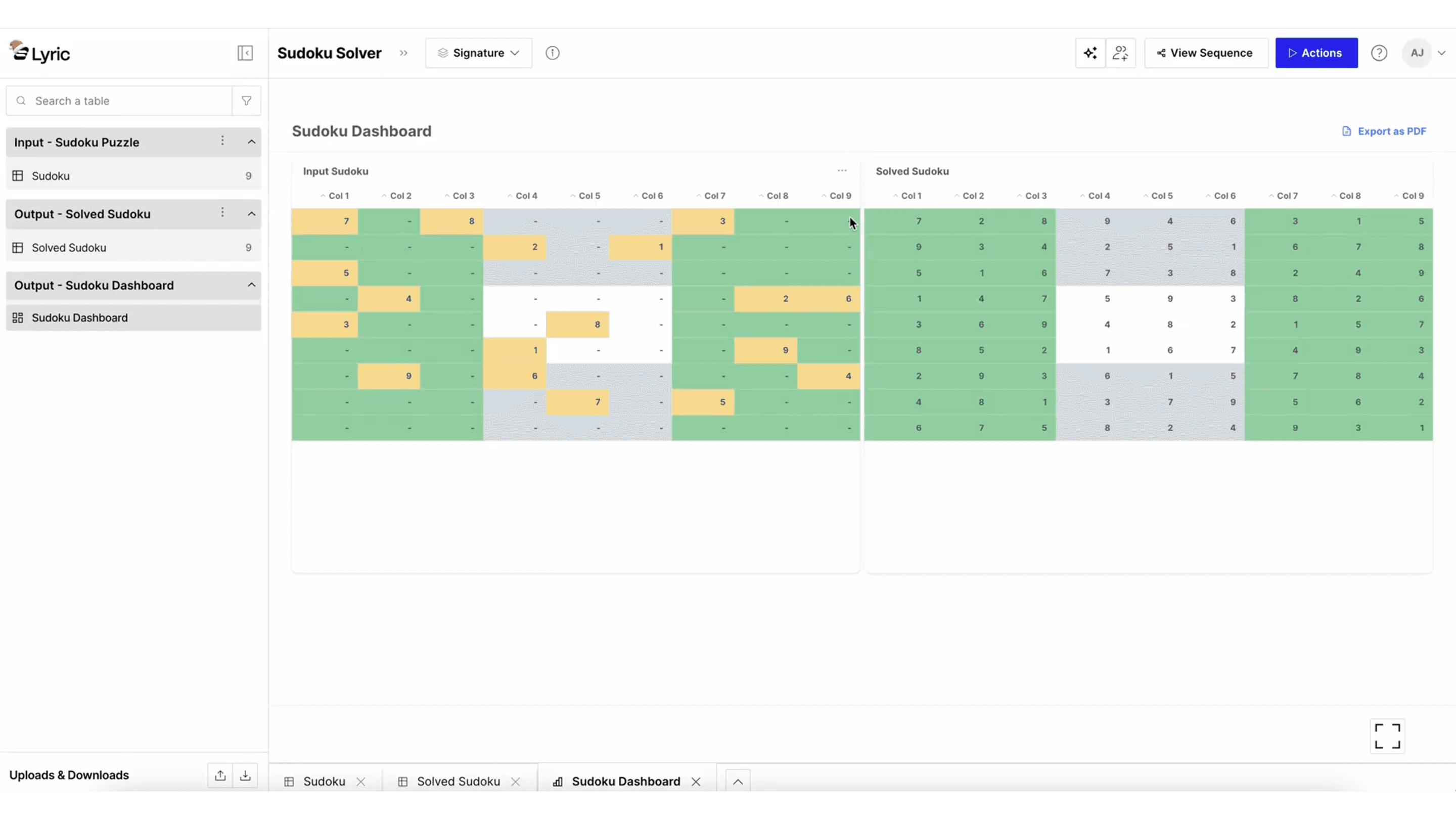
At that point, all that's left is to define an input data model that captures a specific Sudoku puzzle and wrap it in an application layer that lets users interact with it—instantly turning the same algorithm into a completely new solution.
Nothing about the algorithm changed. Only the data model and the constraints did.
That's the key point.
The Core Insight: Algorithms, Models, and Applications Are Orthogonal
Here's the realization: algorithms, data models, and applications are distinct layers and they shouldn't be glued together.
The algorithm is a general-purpose problem solver
The data model defines the structure and rules
The application provides context and user interaction
What we call a "use case" is just the same algorithm with different wrapping.
Most enterprise software ignores this separation. The layers are tightly coupled: the algorithm is buried, the data model is rigid, the application dictates what you can solve.
This creates the illusion of specialization while quietly restricting flexibility. When a new problem emerges, you're told to buy another tool.
"When algorithms are treated as sacred and applications as rigid, organizations become dependent on vendors to define what problems they can solve."
Decouple these layers and everything changes. When the algorithm is reusable, the data model is configurable, and the application is lightweight, power shifts to the modeler. New problems can be expressed directly. Assumptions can change without vendor approval. Entire decision frameworks can be created without reinventing the math.
Translation: The math is reusable. The data model defines the problem. The application is just the interface. Separate these layers, and suddenly you don't need a new tool for every new question.
This is what enables real decision agility, not another "purpose-built" application.
"When the algorithm is reusable, the data model is configurable, and the application is lightweight, the power shifts to the modeler."
Business Implications: The Illusion of New Use Cases
This is where the Sudoku example stops being cute and starts being uncomfortable.
Take a few "distinct" enterprise problems:
Use Case: Tariff Optimization
When tariffs were introduced, organizations scrambled for tariff intelligence tools. Leaders needed to understand how sudden duty changes would impact landed cost, sourcing decisions, and network flows—often with little notice.
Business requirements included:
Evaluating alternate sourcing countries and suppliers
Recomputing landed costs under different tariff regimes
Understanding exposure across products, lanes, and regions
Responding quickly as trade policies evolved
What made this feel like a new use case was the conditional and policy-driven nature of costs. Tariffs depend on origin, destination, product classification, and regulatory rules—not just distance or volume.
But structurally, this is still a network optimization problem:
Flows move from suppliers to demand points
Costs are applied to those flows
Constraints and penalties guide feasible solutions
Tariffs simply become conditional costs and constraints layered onto the network.
Same algorithm. Different data.
The Pattern Repeats
Rough-cut capacity planning? Flows through resources with capacity limits. Labor planning? Workers as resources, tasks as demand, assignments as flows.
Each looks different because the business semantics change:
Policies instead of distances
Capacity instead of locations
People instead of machines
But the mathematical structure doesn't.
What changes is the data model and the user experience, not the algorithm. That distinction is where real flexibility comes from.
What This Means Going Forward
When algorithms are treated as sacred and applications as rigid, organizations become dependent on vendors to define what problems they can solve.
When data models and applications are flexible, the organization regains control.
This has profound implications:
New business problems don't require new solvers
Innovation happens at the modeling layer
Decision intelligence becomes composable, not monolithic
The future doesn't belong to software that ships "use cases." It belongs to platforms that let you define problems.
The Takeaway
Solving Sudoku with a network optimization algorithm isn't the point.
The point is this: most business problems are variations of the same mathematical structures, disguised by different language and interfaces.
When we stop mistaking costumes for substance, we stop chasing tools—and start building decision systems that actually adapt.
"The real competitive advantage isn't owning more applications. It's owning the ability to model your world."
If you're curious to see how this works in practice, how a Sudoku solver (or tariff optimizer, or capacity planner) can be built by cleanly separating algorithms, data models, and applications, check out what's possible in Lyric Studio.
Read more
Leadership & Decision Culture
The Counterpoint
May 27, 2026
Dinesh Natarajan
read more
Decision Intelligence
No Destination Stays Still
May 5, 2026
Brooke Collins & Sonja Jones
read more
Optimization Science & Modeling
Why Optimization Needs Simulation
Apr 14, 2026
Ratnaji Vanga
read more
Engineering Insights
The Real Reason Your Planning System Slows Down
Apr 13, 2026
Aditya Jaroli & Pradeep Vijayakumar
read more
Planning & Forecasting
Teaching Supply Plans to See Around Corners
Apr 6, 2026
Ugo Rosolia
read more
Planning & Forecasting
Why Your Planning Software is Holding You Back
Apr 1, 2026
Deb Mohanty
read more
Planning & Forecasting
Why Your Planning System Should Think Like a Perishable
Mar 23, 2026
Brian Howard Dye
read more
Planning & Forecasting
The Modeling-Planning Divide Was Always a Technology Problem
Mar 19, 2026
Vish Oza & Deb Mohanty
read more
Leadership & Decision Culture
The Innovation Tax: Why Your Best Work Doesn't Compound
Feb 18, 2026
Brittany Elder
read more
Decision Intelligence
Taming the Toughest Problems in Transportation
Dec 18, 2025
Amit Hooda & Priyesh Kumar
read more
Leadership & Decision Culture
Why 30% of Packaged Food Never Reaches a Consumer
Dec 22, 2025
Srivatsan Kadambi Seshadri & Thilak Satya Sree
read more
Leadership & Decision Culture
How to Plan When Nothing Goes According to Plan
Dec 15, 2025
Dr. Nilendra Singh Pawar
read more
Architecture & Composability
Why We Fall Back to Heuristics
Nov 24, 2025
Frank Corrigan
read more
Architecture & Composability
What You Group is What You See
Nov 3, 2025
Frank Corrigan
read more
Architecture & Composability
The Cost of Curiosity
Sep 24, 2025
Brooke Collins
read more
Leadership & Decision Culture
Lyric Named a 2025 Gartner® Cool Vendor in Cross-Functional Supply Chain Technology
Sep 2, 2025
Sara Hoormann
read more
Leadership & Decision Culture
Built for Builders. Backed to Scale.
Aug 5, 2025
Ganesh Ramakrishna
read more
Architecture & Composability
Generative AI meets Time Series Forecasting
May 2, 2025
Deb Mohanty
read more
Architecture & Composability
The Dying Art of Supply Chain Modeling
Apr 15, 2025
Milind Kanetkar
read more
Leadership & Decision Culture
Tariffs, Trade Wars, and the AI Advantage: Why Fast Modeling Wins
Apr 7, 2025
Lyric Team | Prime Contributors - Laura Carpenter, Victoria Richmond, Saurav Sahay
read more
Architecture & Composability
Lyric Leverages NVIDIA cuOpt to Elevate Supply Chain AI
Mar 18, 2025
Sara Hoormann
read more
Architecture & Composability
The Technology Behind Modeling at Scale
Mar 14, 2025
Ganesh Ramakrishna
read more
Leadership & Decision Culture
Our Dream is to Make Every Supply Chain AI-First
Oct 18, 2023
Ganesh Ramakrishna
read more
Architecture & Composability
What Is a Feature Store Anyway?
Mar 14, 2024
Sara Hoormann
read more
Leadership & Decision Culture
Supply Chain AI Ain’t Easy
Feb 20, 2023
Ganesh Ramakrishna & Sara Hoormann
read more
Decision Intelligence
Four Ways to Improve Supply Chain Operations with Machine Learning
Jan 26, 2023
Vish Oza
read more
Architecture & Composability
Prediction is the New Visualization
May 30, 2024
Frank Corrigan
read more